Your fermenters are full. Your brite tank won't be free until Thursday. And you've got a taproom release next weekend that needs a fresh batch of hazy IPA. Sound familiar?
Tank availability is the single biggest bottleneck in brewery production scheduling. It doesn't matter how fast your brewhouse turns around batches if every fermenter is occupied and your brite tanks are backed up. The brew day you planned for Monday gets pushed to Wednesday, which pushes the next batch to the following week, and suddenly your entire production calendar is a mess.
The good news? This problem is completely solvable. It just requires a shift in how you think about scheduling. Instead of starting with what you want to brew and when, you start with what's available and work backward. This guide walks you through the practical, step-by-step process of scheduling brew days around tank availability so you can maximize output, reduce idle time, and stop playing Tetris with your production calendar.
Whether you're running a 3-barrel nano setup or a 30-barrel production facility, BrewPlanner gives you a visual dashboard that maps your entire tank pipeline at a glance. But before we talk tools, let's talk strategy.
Understanding Your Tank Pipeline and Where Bottlenecks Actually Live
Most brewers think about production in terms of brew days. "We brew Monday, Wednesday, and Friday." That's a brewhouse-centric view, and it misses the bigger picture. Your brewery isn't just a brewhouse. It's a pipeline with three distinct phases, each with its own capacity constraints.
Your brewhouse is where the batch starts. Depending on your system, a brew day takes anywhere from 4 to 10 hours. The brewhouse is rarely the bottleneck because it turns over daily. The real constraints live downstream.
Fermenters are where batches spend the most time. A standard ale might occupy a fermenter for 10 to 14 days. A lager could sit for 4 to 6 weeks. A barrel-aged stout? Months. This is where most scheduling conflicts happen because fermenter residency times vary wildly by beer style, and you can't rush biology.
Brite tanks are the final stage before packaging. Batches typically spend 2 to 7 days in a brite tank for carbonation and clarification. Brite tanks become bottlenecks when packaging gets delayed, when you're running multiple taproom lines from the same tank, or when you simply don't have enough brite capacity relative to your fermenter count.
Here's the key insight: your maximum brewing frequency is determined by your slowest phase, not your fastest one. If you have four fermenters and each batch occupies one for 14 days, you can only start a new batch every 3.5 days on average, regardless of how quickly your brewhouse can turn around.
Mapping Your Actual Capacity
Before you can schedule effectively, you need to know your real numbers. Grab a spreadsheet or a piece of paper and document the following for each tank in your brewery:
- Tank type: Brewhouse (BH), Fermenter (FV), or Brite Tank (BT)
- Working volume: Not nameplate capacity, but how much you actually put in it
- Average occupancy time per beer style: Track this for your core beers and seasonal rotations
- Turnaround time: How long it takes to clean, sanitize, and prep the tank between batches
Once you have these numbers, calculate your theoretical maximum throughput. For example:
Tank TypeCountAvg. OccupancyTurnaroundEffective CycleBrewhouse11 day0.5 days1.5 daysFermenter414 days1 day15 daysBrite Tank25 days0.5 days5.5 days
With four fermenters on 15-day cycles, you can start a new fermentation every 3.75 days (15 divided by 4). Your brewhouse can handle a batch every 1.5 days, so it's not the constraint. Your two brite tanks on 5.5-day cycles mean a brite tank opens up every 2.75 days. In this scenario, fermentation is your bottleneck, and you should plan to brew roughly every 4 days.
This exercise alone is worth its weight in gold. Most brewers who do this for the first time discover that they've been either over-scheduling (leading to tanks sitting full with nowhere to transfer) or under-scheduling (leaving expensive equipment idle).
Identifying Your Constraint
Once you've mapped capacity, identify which phase is your constraint. Then ask: what can I do to relieve pressure on that phase? Options include shortening fermentation times where style permits, adding tanks to the bottleneck phase, staggering batch sizes to match tank volumes, and adjusting your beer mix to favor styles with shorter residency times. The goal isn't to eliminate the bottleneck entirely. It's to understand it so you can schedule around it intelligently.
Building a Tank-First Production Schedule
Traditional brewery scheduling starts with the question: "What do we need to brew?" Tank-first scheduling flips this and asks: "When will a tank be available, and what should we put in it?"
This sounds like a small change, but it transforms how you plan production. Instead of forcing batches into a calendar and hoping tanks are free, you let tank availability drive your brew day timing.
Step 1: Plot Your Current Tank Occupancy
Start by creating a visual timeline showing every tank and what's in it right now. For each occupied tank, mark the expected date it will be empty and ready for the next batch. This gives you a forward-looking view of when capacity opens up.
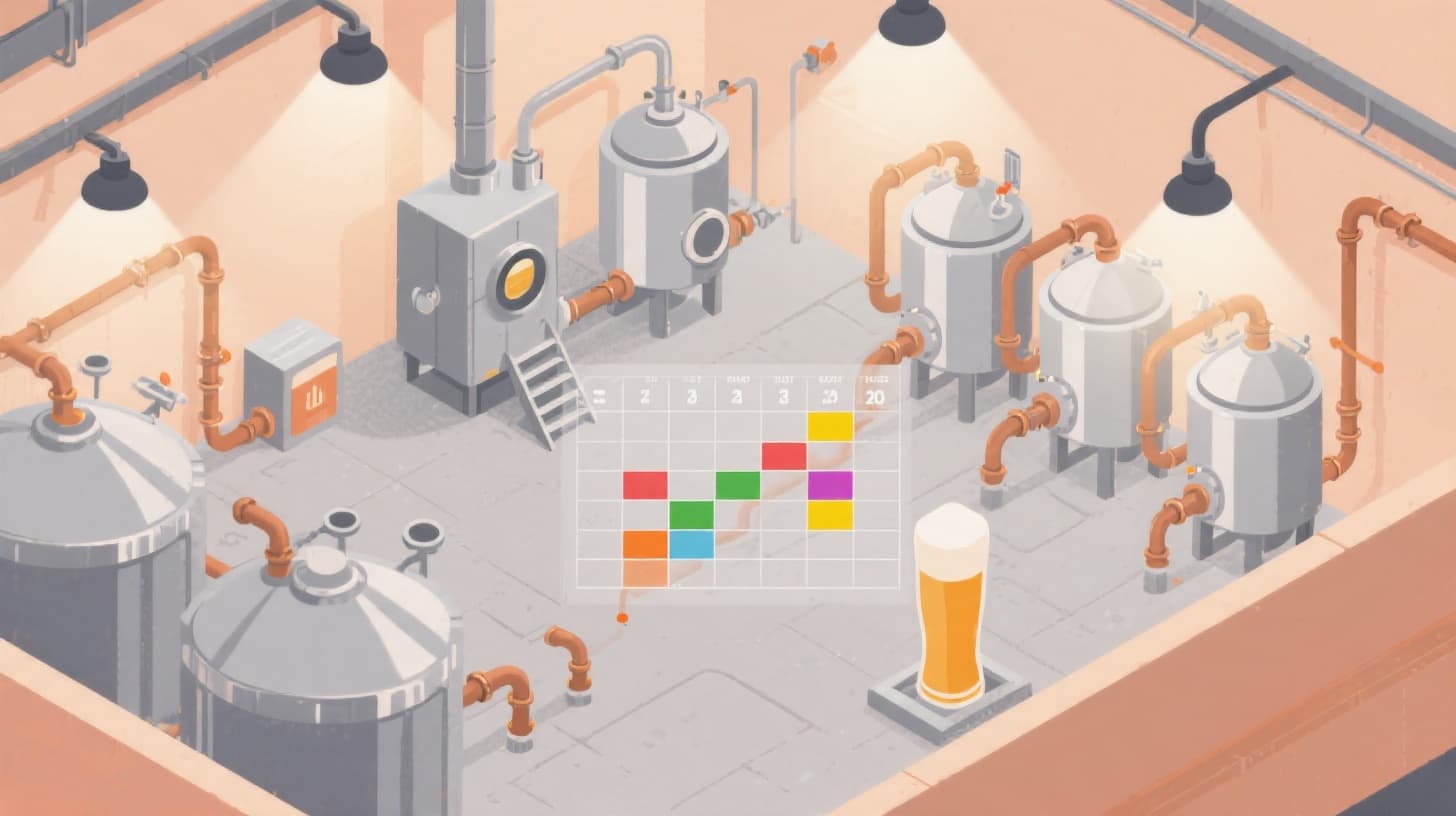
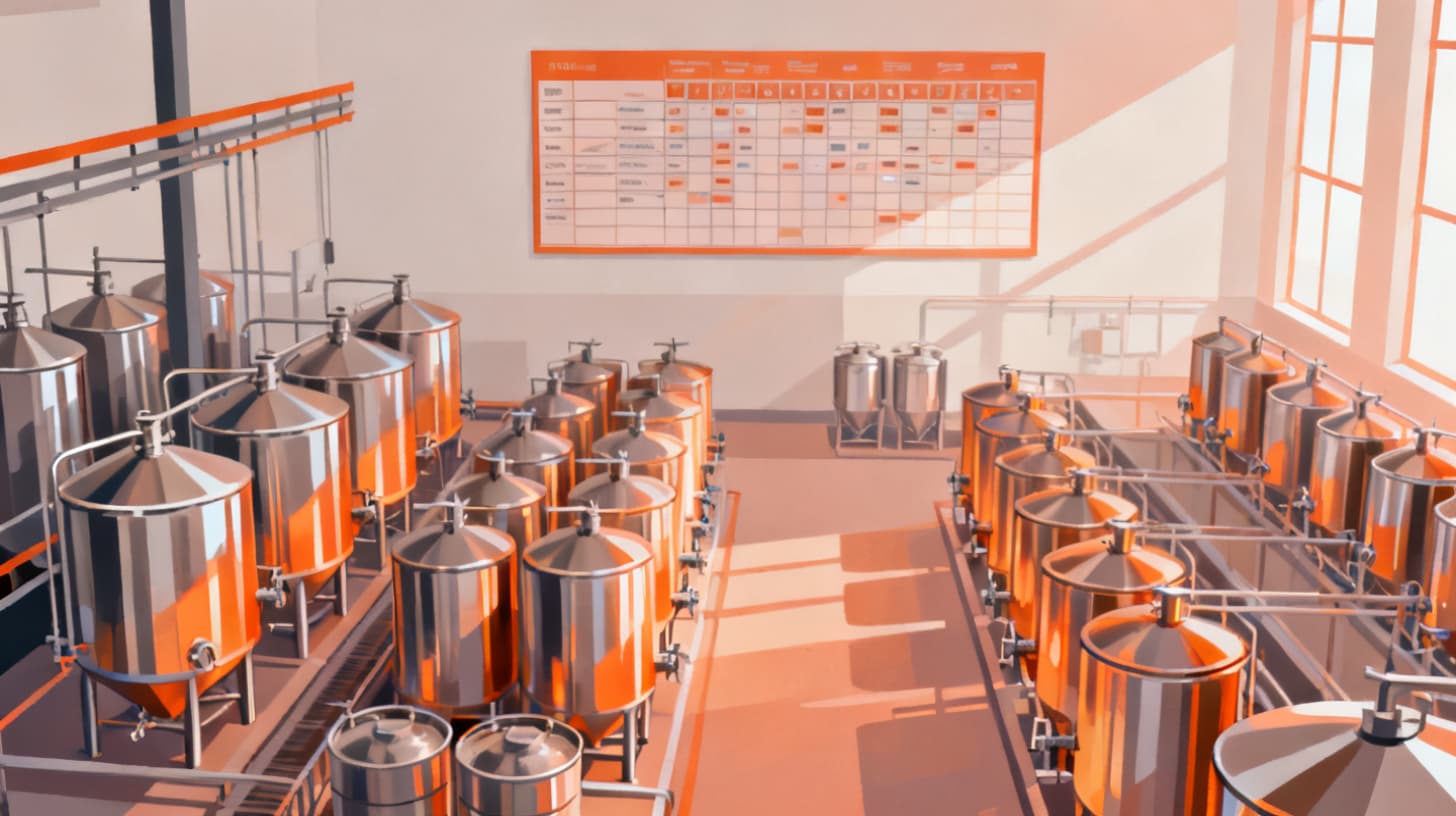
A simple grid works well here. Put tanks on the vertical axis and dates on the horizontal axis. Color-code each batch so you can see at a glance which tanks are occupied, which are in turnaround, and which are available. This is exactly what BrewPlanner's visual dashboard does with drag-and-drop scheduling across brewhouse, fermenter, and brite tank phases, but you can start with a whiteboard if that's where you are.
Step 2: Identify Your Next Available Windows
Look at your timeline and find the next dates when a fermenter will be free. Those dates determine when you can brew next. If Fermenter 2 opens up on Tuesday and Fermenter 4 opens up on Friday, you have two potential brew days in that week.
Now check downstream. Will a brite tank be available when those fermentation batches finish? If you're putting an IPA in Fermenter 2 on Tuesday with a 12-day fermentation, you need a brite tank available around two Sundays from now. Trace each batch through the full pipeline to make sure there are no collisions.
This is where things get tricky with pen and paper, and it's where most breweries start running into scheduling errors. A batch finishes fermenting but there's no brite tank available, so it sits in the fermenter an extra three days. That pushes back the next batch that was supposed to go into that fermenter. One delay cascades into two or three.
Step 3: Assign Batches to Windows
Once you know your available windows, match them to your production needs. Prioritize based on:
- 1Committed orders and taproom needs with hard deadlines
- 2Core beers that maintain consistent availability
- 3Seasonal or special releases with flexible timing
- 4Experimental batches that can fill gaps
When assigning batches, consider tank sizing. If your open fermenter is a 10-barrel tank, don't schedule a 7-barrel batch unless you're comfortable with the headspace. Match batch sizes to tank volumes for the best results.
Step 4: Build in Buffer Time
Fermentation doesn't always finish on schedule. Dry hopping might take an extra day. A stuck fermentation could add a week. Build buffer days into your schedule, especially between the end of fermentation and the start of the next batch in that tank.
A good rule of thumb is to add one buffer day for every seven days of fermentation. So a 14-day fermentation gets a 2-day buffer. This prevents the cascade effect where one slow batch throws off your entire month.
If you're looking for a deeper dive into how visual scheduling tools replace fragile spreadsheet methods, check out this post on moving from spreadsheets to drag-and-drop planning.
Optimizing Your Beer Mix for Maximum Tank Utilization
Here's something that doesn't get talked about enough in brewery production planning: your beer lineup is a scheduling decision, not just a marketing one. The styles you choose to brew directly impact how efficiently you use your tanks.
Consider two breweries with identical equipment: four fermenters and two brite tanks. Brewery A brews mostly lagers with 30-day fermentation cycles. Brewery B brews mostly ales with 12-day cycles. Brewery B can push roughly 2.5 times more batches through the same equipment.
This doesn't mean you should only brew ales. It means you should be intentional about how you balance your mix to keep tanks moving.
Balancing Fast and Slow Beers
Think of your fermenters as lanes on a highway. If every lane is occupied by a slow-moving truck (a lager or barrel-aged beer), nothing gets through. But if you mix fast and slow traffic, the fast lanes keep overall throughput high.
A practical approach: designate specific tanks for long-residency beers and keep the rest free for faster-turning styles. If you have four fermenters, you might dedicate one to your pilsner (which takes 30 days) and rotate ales through the other three on 10-to-14-day cycles. This way, the long-cycle beer never blocks your short-cycle production.
You can also sequence strategically. If you know Fermenter 3 will be occupied for 30 days with a lager, schedule the brew to start right after you've just freed up Fermenters 1 and 2. That way, you still have two fast-turning fermenters available while the lager does its thing.
Right-Sizing Batches to Tank Volumes
Another underused optimization is matching batch sizes to tank volumes. If you have a mix of 7-barrel and 15-barrel fermenters, brew your high-volume core beers in the 15-barrel tanks and your specialty releases in the 7-barrel tanks. This seems obvious, but many breweries default to brewing the same batch size regardless of the tank, leaving capacity on the table.
The SBA's business planning resources emphasize that equipment utilization is one of the most impactful levers for operational efficiency in manufacturing businesses. Breweries are no different. Every day a tank sits partially full or completely idle is money you're leaving behind.
Using Packaging Days as Schedule Anchors
Your packaging schedule is just as important as your brew schedule for keeping tanks available. If you only package on Fridays, every brite tank batch needs to be ready by Friday morning. That creates a traffic jam where multiple batches compete for brite tank space mid-week.
Consider packaging twice per week, or even three times if your volume supports it. More frequent packaging means shorter brite tank residency, which means more brite tank availability, which means fewer fermentation transfers get delayed.
You can also use packaging days as fixed anchors in your schedule and work backward. If you package every Tuesday and Friday, a beer that needs 5 days in the brite tank should transfer from the fermenter on Thursday or Sunday. That fermenter then needs to be available 12 days before that transfer date (for a typical ale). Tracing backward from packaging to brew day gives you a precise brew date for each batch.
Explore how BrewPlanner's features handle this exact workflow with tank management, order lifecycle tracking, and batch scheduling tools designed to keep your pipeline moving.
Putting It All Together With a Repeatable Planning Rhythm
Scheduling brew days around tank availability isn't a one-time exercise. It's a weekly discipline. The breweries that run the smoothest production operations have a repeatable planning rhythm that keeps their schedule current and accurate.
Here's a practical framework you can adopt starting this week.
The Weekly Production Planning Meeting
Set aside 30 minutes every week for a focused production planning session. This works best at the same time each week so it becomes a habit. During this meeting, review three things:
- Current tank status: What's in each tank? What's the expected completion date? Any delays or issues?
- Upcoming availability: Which tanks will open up in the next 7 to 14 days? Are there downstream tanks available for transfers?
- Production priorities: What needs to be brewed based on sales commitments, taproom needs, and distribution orders?
With these three inputs, you can set your brew days for the coming week and tentatively plan the week after. Keep the tentative schedule flexible since fermentation timelines might shift as the week progresses.
Tracking What Actually Happens
The secret to getting better at scheduling over time is tracking actual versus planned timelines. Every time a batch finishes faster or slower than expected, update your averages. Over time, your estimates get tighter, your buffers get smaller, and your throughput increases.
Track these metrics for each batch:
MetricWhy It MattersPlanned vs. actual fermentation daysTightens your scheduling estimatesTank turnaround timeReveals cleaning/prep bottlenecksDays between brew daysShows your actual brewing cadenceTank idle days per monthHighlights underutilized capacitySchedule changes per weekMeasures planning accuracy
If you're averaging more than two schedule changes per week, your estimates need recalibration. If tank idle days are climbing, you might be under-scheduling or your beer mix has shifted toward longer-cycle styles without you realizing it.
When to Invest in More Tanks
At some point, scheduling optimization hits a ceiling. You simply can't squeeze more output from the tanks you have. How do you know when you've hit that point?
Look at your tank idle days. If they're near zero and you're still unable to meet demand, you need more tanks. If you have significant idle time but are still bottlenecked, the issue is scheduling, not capacity, and better planning will solve it.
Also consider which type of tank to add. If your fermenters are the bottleneck, adding another fermenter will increase throughput. But if your brite tanks are always full because packaging is infrequent, a new fermenter won't help. Add capacity at the constraint.
This is where having a clear, visual picture of your entire production pipeline makes all the difference. You can see exactly where batches are stacking up and where the open space lives. BrewPlanner's pricing plans offer options for breweries at every scale, from nano startups to full production facilities, so you can get this visibility without building it from scratch.
The best time to fix your production scheduling was six months ago. The second best time is right now.
Start with the tank mapping exercise from section one. Build a visual timeline of your current tank occupancy. Identify your bottleneck phase. Then shift to a tank-first scheduling approach where availability drives your brew days instead of the other way around.
Your beer will be fresher, your equipment will be busier, and your Monday mornings will be a lot less stressful. That's a production plan worth brewing for.