A single missed tank turnover can cascade through your entire production week. One fermenter that sits occupied two days longer than planned means the next batch waits in the brewhouse, the batch after that gets pushed to next week, and suddenly your taproom is running low on your flagship IPA. If this scenario sounds painfully familiar, you're not alone. Tank scheduling is one of the most operationally complex challenges in craft brewing, and most breweries don't realize how much revenue they're leaving on the table until they map out the problem.
The good news? Building a reliable tank scheduling system isn't about buying more tanks or hiring more staff. It's about visibility, structure, and rhythm. In this guide, we'll walk through a practical framework for setting up a brewery tank scheduling system that keeps production flowing, eliminates guesswork, and scales with your growth. And if you want to skip the spreadsheet headaches entirely, BrewPlanner gives you a visual dashboard scheduling grid with drag-and-drop tank assignment across every phase of production.
Let's dig in.
Understanding Why Production Bottlenecks Happen in Breweries
Before you can fix a bottleneck, you need to understand where they form and why. In brewery operations, bottlenecks rarely come from a single dramatic failure. They build quietly through a combination of small misalignments that compound over time.
The Three-Phase Constraint
Every batch of beer moves through at least three major phases that each require tank time: the brewhouse (BH), fermentation vessels (FV), and brite tanks (BT). Each phase has a different duration and a different set of constraints. A typical brew day in the brewhouse takes 6 to 10 hours. Fermentation might take 5 to 14 days depending on the style. Brite tank conditioning and carbonation can take 2 to 7 days. The problem is that these phases don't move in lockstep.
Imagine you have two fermenters and one brite tank. You brew Batch A on Monday and transfer it to Fermenter 1. You brew Batch B on Tuesday and fill Fermenter 2. Batch A finishes fermenting on Saturday, but your single brite tank is still occupied with last week's lager that hasn't been fully packaged. Now Batch A sits in the fermenter, Batch B can't move up, and your Wednesday brew day for Batch C gets cancelled because there's no fermenter available. That one brite tank became a chokepoint for your entire operation.
This is the fundamental scheduling challenge: mismatched phase durations create invisible queues that only become visible when it's too late to react.
Common Root Causes
There are several recurring patterns that cause tank scheduling bottlenecks in breweries of all sizes:
- No centralized view of tank status. When tank occupancy lives in someone's head or across multiple whiteboards and spreadsheets, it's nearly impossible to see conflicts more than a few days out.
- Variable fermentation times. Different beer styles require vastly different fermentation windows. A clean lager might need 21 days of tank time while a session ale needs 7. Mixing these on the same schedule without planning creates unpredictable gaps and overlaps.
- Packaging delays. If your packaging line runs on a fixed schedule (say, Tuesdays and Thursdays), brite tanks can sit occupied for days waiting for their turn. This downstream delay backs up everything upstream.
- No buffer time between batches. Tanks need cleaning, inspection, and sometimes maintenance between batches. Failing to account for CIP (clean-in-place) cycles when scheduling means your "available Tuesday" fermenter is actually available Wednesday afternoon.
- Reactive rather than proactive scheduling. Many breweries schedule their next brew day based on what's happening today rather than looking two or three weeks ahead. By the time you spot a conflict, your options are limited.
The Brewers Association notes that production efficiency is one of the top operational concerns for craft breweries, especially as they scale beyond initial capacity. Addressing tank scheduling systematically is one of the highest-leverage improvements a brewery can make.
The takeaway here is simple: bottlenecks aren't caused by not having enough tanks. They're caused by not having enough visibility into how your existing tanks are being used. Once you see the full picture, solutions become obvious.
Building Your Tank Scheduling Framework from Scratch
Now that you understand where bottlenecks come from, let's build a scheduling system that prevents them. This framework works whether you're running a 3-barrel pilot system or a 30-barrel production brewery. The principles are the same; only the scale changes.
Step 1: Audit and Catalog Every Tank
Start by creating a complete inventory of every vessel in your brewery. For each tank, document:
- Tank name/number (e.g., FV-01, BT-03)
- Tank type (brewhouse, fermenter, or brite tank)
- Working volume in barrels or hectoliters
- Typical turnaround time including CIP
- Any constraints (temperature control limitations, glycol capacity, physical location issues)
This catalog becomes your scheduling foundation. You can't schedule what you can't see. Many breweries discover during this audit that they have capacity they didn't realize, or that certain tanks have limitations that were only known to one person on the team.
A platform like BrewPlanner lets you set up each tank with its type and volume, giving your whole team a shared source of truth for tank availability.
Step 2: Map Your Beer Styles to Tank Time Requirements
Next, build a reference chart for every beer style you regularly produce. For each style, estimate:
Beer StyleBrewhouse TimeFermentation DaysBrite Tank DaysTotal Tank DaysAmerican IPA1 day10314Hefeweizen1 day7210Czech Pilsner1 day21729Imperial Stout1 day14520Session Ale1 day528
This table immediately reveals why scheduling a Czech Pilsner alongside a Session Ale creates problems. The Pilsner ties up a fermenter for three weeks while the Session Ale moves through in five days. If you don't account for this difference, you'll unknowingly create a three-week bottleneck every time you brew a lager.
Step 3: Create a Visual Timeline
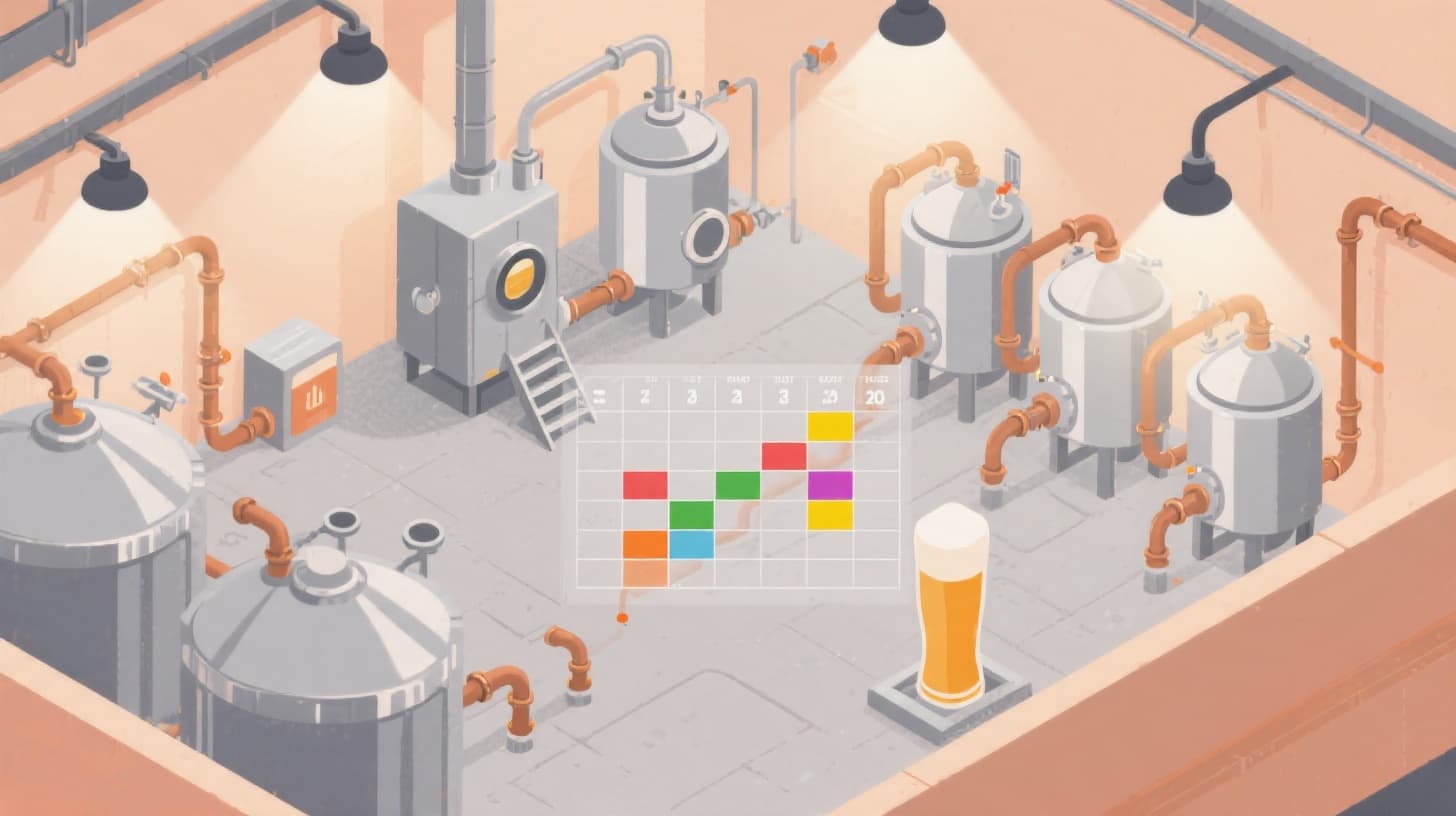
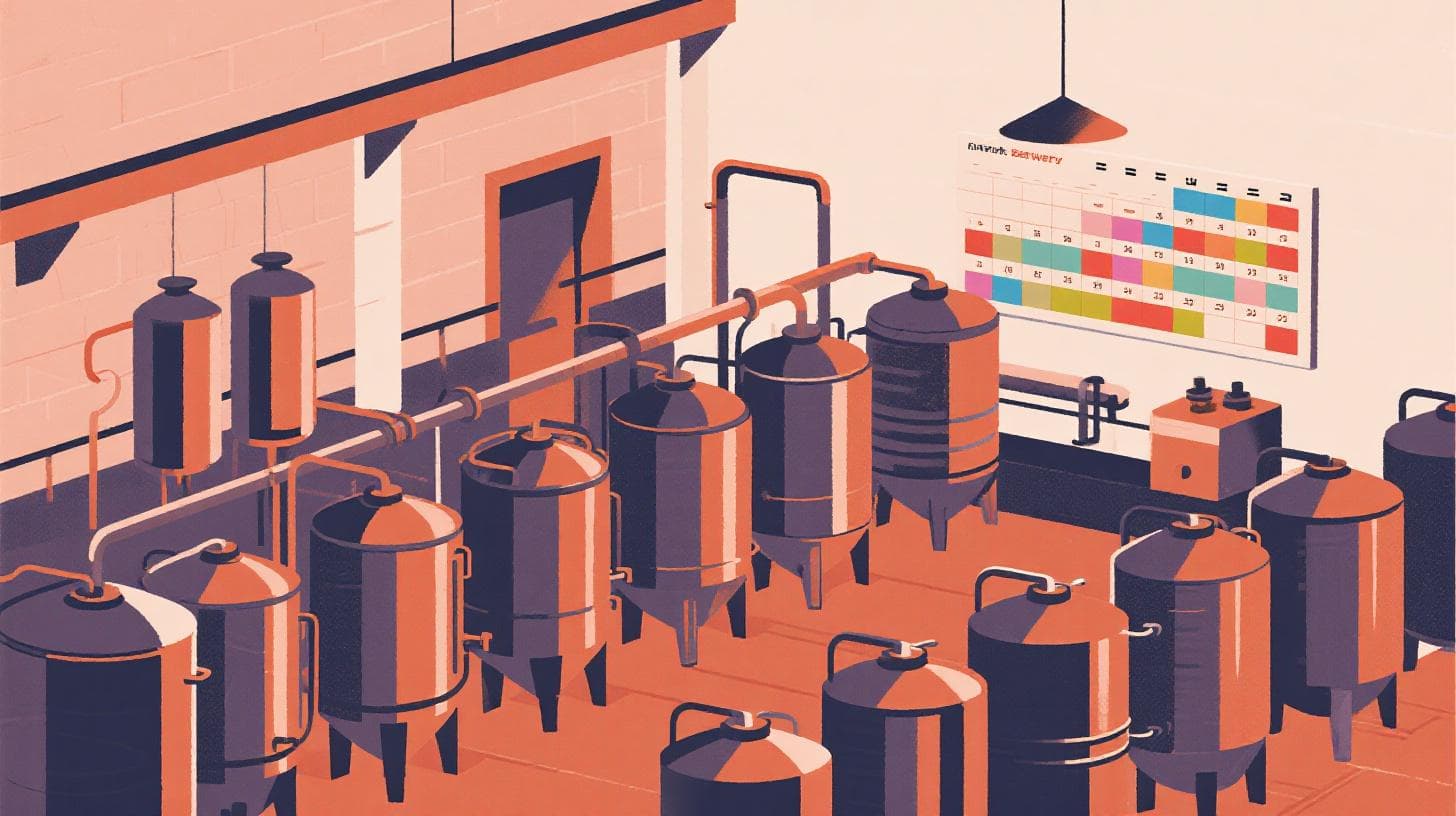
Here's where everything comes together. Take your tank catalog and your style-to-time mapping and lay them out on a timeline. The most effective approach is a grid where:
- The vertical axis lists every tank
- The horizontal axis shows calendar days
- Color-coded blocks represent batches occupying each tank
This visual format instantly reveals conflicts. If two blocks overlap on the same tank, you have a problem. If there's a gap between blocks, you have an opportunity. If your brite tanks are always full when fermenters are ready to transfer, you've found your bottleneck.
You can do this on a whiteboard, in a spreadsheet, or in purpose-built software. The critical thing is that it's visual and accessible to everyone involved in production decisions. If you've ever tried managing this in a spreadsheet and felt the pain of formulas breaking and rows not lining up, you might appreciate how BrewPlanner's drag-and-drop scheduling grid handles this natively, letting you move batches between tanks and phases with a simple click.
Step 4: Build in Buffer Zones
Once your timeline is in place, add realistic buffer time between each batch on every tank. A good rule of thumb:
- Brewhouse: 0.5 days for CIP and prep between brews
- Fermenters: 1 day for CIP, inspection, and any dry-hop additions or harvesting
- Brite tanks: 0.5 to 1 day for CIP and carbonation checks
These buffers feel like lost production time, but they're actually what keeps the entire schedule reliable. Without them, one batch that runs even a few hours long cascades into delays across every downstream tank.
Optimizing Your Schedule for Maximum Throughput
Having a framework in place is the first step. Making it work efficiently over weeks and months requires ongoing optimization. Here are the strategies that separate breweries with smooth operations from those constantly firefighting.
Batch Sequencing Strategy
The order in which you brew matters more than most people think. Grouping similar styles together reduces changeover time and creates predictable fermentation windows. For example, if you brew three ales back-to-back followed by a lager, your fermenter turnover stays fast for the first three batches before committing a fermenter to the longer lager cycle.
A practical sequencing approach:
- 1Start each production cycle with your fastest-turning beers. This frees up fermenters quickly and keeps downstream phases moving.
- 2Schedule long-fermentation styles to land in fermenters at the end of your weekly brewing cycle. They'll occupy the tank over the weekend or through a period when the brewhouse is idle anyway.
- 3Align packaging days with brite tank readiness. If you package on Tuesdays and Fridays, work backward from those dates to determine when each batch needs to hit the brite tank.
This backward-scheduling approach, starting from the customer-facing deadline (packaging day, taproom rotation, distributor delivery) and working backward through each phase, is how professional production planners in every manufacturing industry operate. Brewing is no different.
Identifying and Breaking Your Constraint
In any production system, there's always one resource that limits overall throughput. In brewing, it's usually one of three things:
- Fermenter capacity (the most common constraint for growing breweries)
- Brite tank availability (common when packaging runs are infrequent)
- Brewhouse frequency (rare, but happens when labor limits brew days)
To find your constraint, look at your visual timeline and ask: Which tank type is at the highest utilization? If your fermenters are occupied 90% of the time while your brite tanks sit empty 40% of the time, fermentation is your bottleneck.
Once identified, every scheduling decision should prioritize keeping that constraint working at maximum efficiency. If fermenters are the bottleneck, never let a fermenter sit empty waiting for a brew day. Adjust your brewhouse schedule to ensure a batch is always ready to fill a fermenter the moment it's cleaned and available.
This principle, borrowed from the Theory of Constraints, is remarkably powerful when applied to brewery operations. You don't optimize everything at once. You find the one thing that's limiting you and organize everything else around keeping it fed.
Schedule Drafting Before Publishing
One practice that dramatically reduces scheduling chaos is separating planning from execution. Instead of making changes directly to your live production schedule, work out the next week or two in a draft environment first. Review it with your head brewer, your packaging lead, and your sales team. Once everyone agrees it's realistic, publish it as the official schedule.
This prevents the all-too-common scenario where someone moves a batch on the whiteboard without telling anyone, and the cellar crew shows up expecting to transfer a beer that isn't ready. A draft-then-publish workflow creates accountability and reduces surprises. If you're curious about how other breweries have moved from ad hoc scheduling to structured visual planning, this piece on moving from spreadsheets to visual drag-and-drop planning covers the transition in detail.
Sustaining Your System and Scaling Production
Setting up a tank scheduling system is a project. Keeping it running smoothly is a discipline. Here's how to make sure your system stays effective as your brewery evolves.
Weekly Scheduling Rituals
The single most impactful habit you can adopt is a weekly production planning meeting. Keep it short (30 minutes max) and focused on three questions:
- 1What's the status of every tank right now? Go through each tank and confirm what's in it, when it's expected to be ready, and whether it's on track.
- 2What are we brewing this week, and where does each batch go? Walk through the upcoming brew days and confirm tank assignments.
- 3Are there any conflicts or risks in the next two weeks? Look ahead on the timeline for overlaps, tight turnarounds, or batches that depend on uncertain fermentation completion.
This meeting replaces the scattered "hey, is FV-03 available?" conversations that happen throughout the week. It creates a shared understanding of the production plan and catches problems while there's still time to adjust.
Tracking Performance Over Time
You can't improve what you don't measure. Start tracking a few simple metrics:
- Tank utilization rate: What percentage of available tank-days are actually occupied by beer? Target 75-85% for fermenters (leaving buffer for cleaning and flexibility).
- Schedule adherence: How often do batches actually transfer and package on the planned date? If you're hitting less than 80%, dig into why.
- Turnaround time: How long does it take from emptying a tank to filling it again? Shortening this by even half a day across all tanks can add significant annual capacity.
These metrics give you a factual basis for capacity planning conversations. Instead of guessing whether you need a new fermenter, you can show that your existing fermenters are at 92% utilization and that adding one vessel would increase annual output by a specific number of barrels.
Scaling Without Losing Control
As your brewery grows, your scheduling system needs to grow with it. The principles stay the same, but the complexity increases. More tanks mean more possible assignments. More beer styles mean more variation in fermentation times. More customers mean tighter deadlines.
This is where manual systems tend to break down. A whiteboard works when you have four tanks and two beer styles. It becomes a liability when you have twelve tanks, eight active styles, and a distribution schedule that changes weekly. The cost of a scheduling error, a missed delivery, a cancelled brew day, a tank of beer that sits too long, grows with every barrel you produce.
Investing in a purpose-built scheduling tool pays for itself quickly at this stage. If you're evaluating options, check out BrewPlanner's pricing to see how a dedicated tank management and scheduling system fits your budget. The goal is to spend your time making great beer, not wrestling with spreadsheets.
Tank scheduling isn't glamorous, but it's the backbone of a well-run brewery. The framework we've covered, cataloging your tanks, mapping style requirements, building a visual timeline, optimizing batch sequencing, and establishing weekly planning rituals, will eliminate the majority of production bottlenecks without requiring a single new piece of equipment.
Start with what you have. Build your tank catalog this week. Map your styles to tank-time requirements. Create a visual schedule, even if it's on a whiteboard. Then refine from there. Every week you run this system, you'll spot inefficiencies you never noticed before and unlock capacity that was hidden in plain sight.
Your beer deserves a production schedule as thoughtful as your recipes. Build one, and your brewery will run smoother than you ever thought possible.