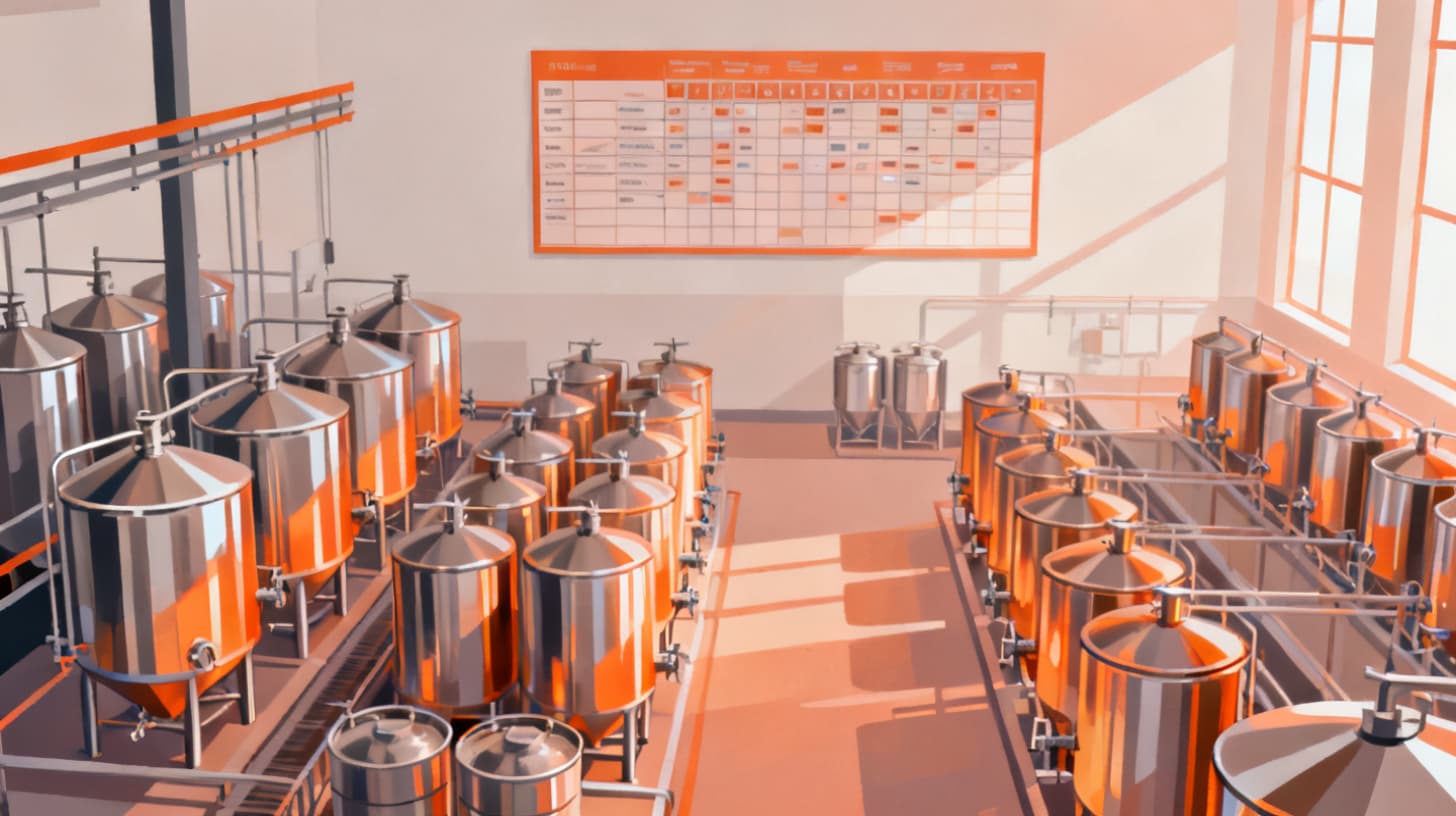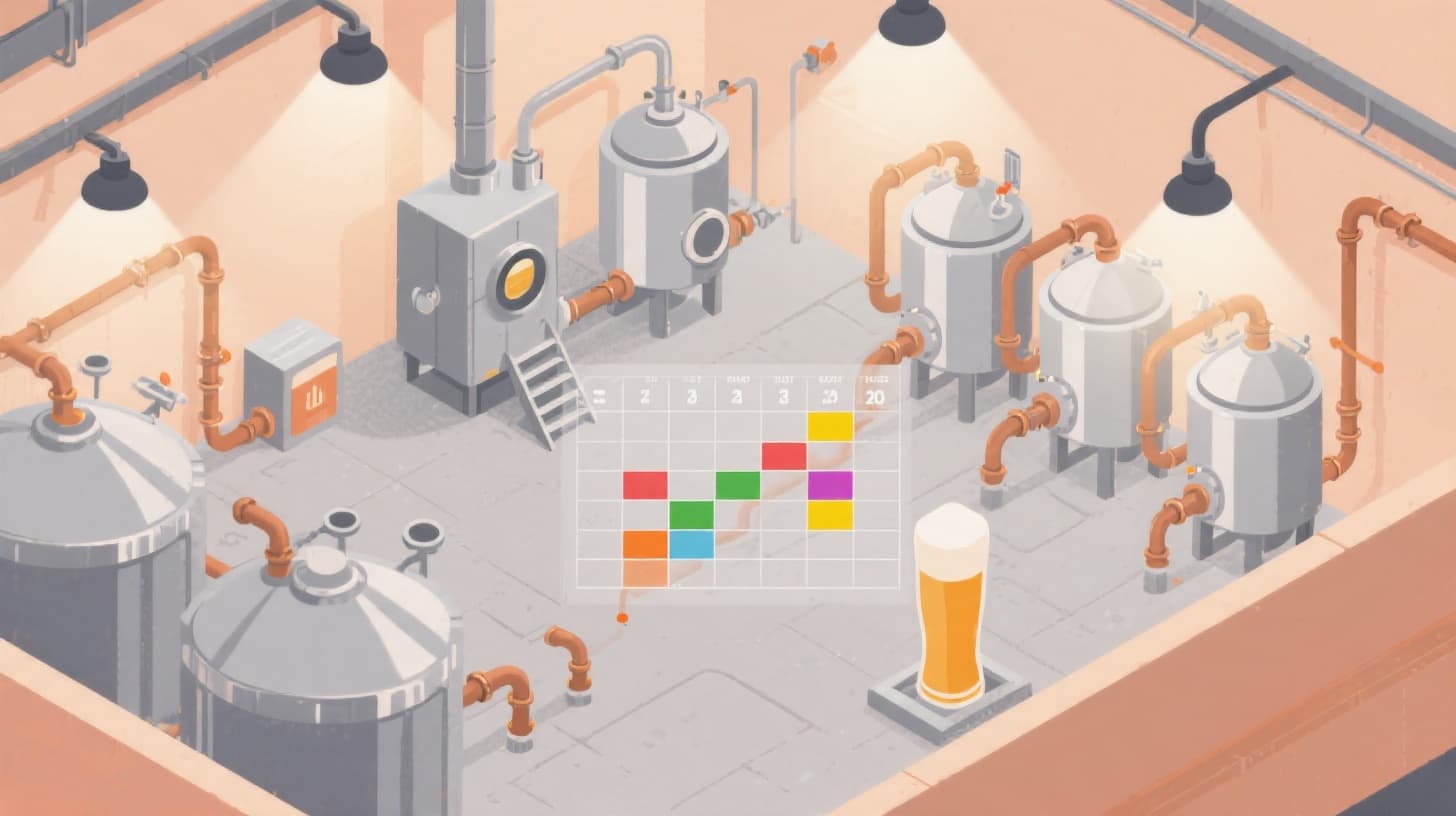
A single overlooked tank can cost a brewery thousands. Maybe it's a fermenter sitting empty for three days because nobody realized a batch was ready to transfer. Maybe it's a brite tank that gets double-booked, forcing your team to scramble for alternatives or delay a packaging run. Whatever the scenario, poor tank management doesn't just create headaches. It eats into your margins, slows your output, and makes scaling feel impossible.
The challenge is straightforward but surprisingly hard to solve: you need to know exactly what's in every vessel, how much is there, how long it's been there, and when it needs to move. Across your brewhouse, fermenters, and brite tanks, that's a lot of moving parts. Spreadsheets can work for a while, but they break down fast once you're running more than a handful of batches per week.
This guide walks you through the fundamentals of brewery tank management, from understanding the role each vessel plays in your production pipeline to building a tracking system that gives you real-time visibility into capacity and scheduling. Whether you're running a 7-barrel brewhouse or managing a 30-barrel operation with dozens of tanks, these principles apply. And if you want to see what purpose-built software looks like for this exact problem, BrewPlanner offers a visual drag-and-drop scheduling grid designed specifically to manage tank assignments across every phase of production.
Let's start with the basics.
Understanding the Three Tank Types and Their Role in Production Flow
Before you can track volumes effectively, you need a clear mental model of how beer moves through your brewery. Every vessel in your facility falls into one of three categories, and each one has different tracking requirements, turnaround pressures, and scheduling implications.
The Brewhouse
Your brewhouse is where production begins. It includes your mash tun, lauter tun, kettle, and whirlpool (or some combination, depending on your system). From a tank management perspective, the brewhouse is your bottleneck gatekeeper. Its capacity determines how many batches you can brew per day, and its turnaround time sets the pace for everything downstream.
Tracking brewhouse volumes means knowing your system's effective batch size (not just its nominal capacity), monitoring how many brews you're completing per day or week, and understanding your turnaround time between batches. If your brewhouse can produce 15 barrels per batch and you can run two batches per day, your maximum weekly throughput is roughly 210 barrels. That number matters because it dictates how many fermenters and brite tanks you need to keep production flowing without gaps.
A common mistake is focusing only on the brewhouse capacity without considering what happens next. If you can brew 210 barrels a week but only have fermenter capacity for 150, you've got a problem. The brewhouse isn't just a production unit. It's the starting pistol for a relay race that runs through every vessel in your facility.
Fermentation Vessels
Fermenters (often labeled FV in production logs) are where your beer spends the most time. Depending on the style, fermentation can take anywhere from 4 days for a simple lager to 4 weeks or more for a barrel-aged stout. This variability is what makes fermenter management the most complex piece of the puzzle.
Volume tracking for fermenters involves monitoring the fill volume (which is usually less than the tank's total capacity to allow headspace for krausen), tracking the current fermentation day, and knowing the expected transfer date. You also need to account for volume loss during fermentation. Yeast, trub, and dry hop material can reduce your effective yield by 5 to 15 percent depending on the recipe.
The scheduling challenge with fermenters is that they're occupied for varying durations. A hefeweizen might free up a tank in 10 days, while an imperial stout ties one up for 28. If you're not tracking these timelines carefully, you'll either run out of fermenter space (stalling your brewhouse) or have tanks sitting empty (wasting capacity you paid good money for).
Brite Tanks
Brite tanks (BT) are the final stop before packaging. Beer transfers from the fermenter to the brite tank for carbonation, clarification, and sometimes blending. Brite tank residence time is typically shorter than fermentation, usually 2 to 7 days, but the scheduling pressure is higher because brite tanks directly feed your packaging line.
Volume tracking here needs to be precise. You need to know the exact volume available for packaging, account for any losses from fining or filtration, and coordinate the transfer timing so your packaging crew isn't waiting around. A brite tank that's ready on Monday but doesn't get packaged until Thursday is wasting capacity that another batch could use.
The interplay between these three vessel types creates a production pipeline where timing is everything. Understanding each tank's role, capacity, and typical residence time is the foundation for building a tracking system that actually works.
Building a Volume Tracking System That Works in Practice
Knowing what your tanks do is one thing. Tracking what's actually happening in them, in real time, is another. The gap between theory and practice is where most breweries struggle, especially as they grow beyond a handful of simultaneous batches.
What to Track and Why
At minimum, your tank tracking system should capture these data points for every vessel:
- Current status: Empty, filled, fermenting, conditioning, carbonating, ready to package
- Batch assignment: Which beer is in this tank, linked to a specific batch or order number
- Fill volume: How many barrels (or hectoliters, gallons, etc.) are currently in the tank
- Fill date: When the tank was filled or transferred into
- Expected transfer or packaging date: When the tank should be available next
- Volume adjustments: Any losses from yeast harvest, dry hopping, fining, or sampling
This isn't just operational data. It's also a compliance requirement. The TTB requires breweries to maintain detailed records of production volumes, transfers, and inventory for federal excise tax purposes. Accurate tank tracking feeds directly into these reporting obligations, so getting it right protects you from both operational headaches and regulatory risk.
Why Spreadsheets Fall Apart
Most breweries start with spreadsheets. A Google Sheet with tank names across the top and dates down the side, color-coded cells showing which tanks are occupied. It works fine when you have 4 fermenters and a predictable brew schedule.
But spreadsheets have three fatal flaws for tank management:
- 1They don't update themselves. Someone has to manually change the status of every tank after every transfer, every packaging run, every CIP cycle. Miss one update and your entire schedule is wrong.
- 2They can't show you the future. A spreadsheet tells you what's happening now (maybe), but it can't model what happens if fermentation on Tank 3 runs two days long, or if a packaging run gets pushed to next week.
- 3They break with multiple users. When your head brewer, cellar team, and packaging crew all need to reference the same tank schedule, version conflicts and stale data become inevitable.
The transition from spreadsheets to a dedicated system is one of the biggest operational upgrades a growing brewery can make. If you've been wrestling with shared Google Sheets and whiteboard schedules, moving to visual drag-and-drop planning can dramatically reduce scheduling errors and save hours of coordination time every week.
Setting Up Effective Tracking
Whether you use software or a well-designed manual system, here's how to structure your tracking:
- Create a master tank list with every vessel's name, type (BH, FV, BT), maximum working volume, and any constraints (e.g., "FV-4 is glycol-only, no steam jacket").
- Assign batch numbers at brew time and carry them through every transfer. This creates traceability from brewhouse to package.
- Log volume at every transfer point. Don't just log when a tank is filled. Log the actual volume going in, then log the volume coming out when it transfers. The difference is your process loss, and tracking it over time reveals patterns you can optimize.
- Set expected dates for every phase. When a fermenter is filled, immediately set the expected transfer date based on your recipe's fermentation schedule. When beer hits the brite tank, set the expected packaging date. These dates drive your forward-looking schedule.
This approach transforms tank management from a reactive scramble into a proactive planning exercise. You're no longer asking "which tanks are empty right now?" You're asking "which tanks will be empty on Thursday, and do I have enough fermenter space for next week's brew schedule?"
Turning Tank Data Into Capacity Planning and Scheduling Decisions
Tracking volumes is the foundation. But the real payoff comes when you use that data to make smarter production decisions, plan capacity expansions, and identify bottlenecks before they stall your operation.
Identifying Your Bottleneck
Every brewery has a bottleneck, and it's not always where you think it is. Some breweries assume their brewhouse limits production, but when they actually map out tank utilization, they discover fermenters are the constraint. Others find that their brite tanks are the chokepoint because packaging runs aren't happening frequently enough.
To find your bottleneck, calculate the utilization rate for each tank type:
Tank TypeFormulaHealthy TargetBrewhouse(Actual brews per week / Maximum possible brews) × 10070-85%Fermenters(Days occupied / Total available tank-days) × 10075-90%Brite Tanks(Days occupied / Total available tank-days) × 10060-80%
If your fermenters are running at 95% utilization while your brewhouse is at 60%, buying another brewhouse won't help. You need more fermenter capacity, or you need to shorten fermentation times, or you need to schedule more strategically to reduce dead time between batches.
With craft brewery numbers continuing to grow and competition intensifying according to Brewers Association production data, maximizing the output from your existing equipment isn't just nice to have. It's a competitive requirement. The breweries that thrive are the ones squeezing every barrel of capacity from their tanks before investing in expensive new vessels.
Reducing Dead Time
Dead time is the gap between when a tank is emptied and when it's filled again. It includes CIP (clean-in-place) time, inspection, and waiting for the next batch. Some dead time is unavoidable, but a lot of it is caused by poor coordination.
Here are concrete ways to reduce it:
- Schedule CIP immediately after transfer. Don't let an empty tank sit dirty overnight. Build CIP into your transfer protocol so the tank is ready for the next batch as fast as possible.
- Align brew days with fermenter availability. If you know FV-6 will be empty Wednesday morning, schedule a brew for Tuesday afternoon so wort is ready to transfer first thing Wednesday.
- Stagger batch sizes. If you have fermenters of different sizes, match your batch sizes to tank availability rather than always brewing full batches. A 10-barrel batch in a 15-barrel fermenter is better than a 15-barrel fermenter sitting empty for three days waiting for a full brew.
- Use your scheduling tool's forward view. This is where BrewPlanner's dashboard grid becomes invaluable. Seeing every tank's timeline on a single visual schedule makes it obvious where gaps exist and where you can tighten the sequence.
Planning for Growth
Your tank utilization data also tells you when it's time to add capacity and which type of vessel to add. If your fermenters are consistently above 85% utilization and you're regularly delaying brews because no tanks are available, that's a clear signal. But if your brite tanks are the constraint, adding fermenters won't solve the problem.
Track these metrics monthly:
- Average utilization by tank type
- Number of scheduling conflicts (times you wanted to brew but couldn't due to tank availability)
- Average dead time per tank (hours between empty and refilled)
- Volume loss per batch (helps you project actual yield vs. nominal capacity)
Over time, these numbers paint a clear picture of where your operation is healthy and where it needs investment. They also give you hard data to bring to investors or lenders when you're ready to fund an expansion.
Putting It All Together: A Practical Tank Management Checklist
Theory is great, but implementation is what matters. Here's a practical checklist you can use to audit and improve your current tank management approach, starting with quick wins and building toward a fully optimized system.
- Create a complete inventory of every vessel with type, working volume, and any equipment constraints
- Establish a batch numbering system that follows beer from brewhouse through packaging
- Log fill volumes and transfer volumes at every stage to track process losses
- Set expected dates for fermentation completion, transfer, and packaging at the time each tank is filled
- Calculate weekly utilization rates for each tank type to identify your true bottleneck
- Track dead time between batches and set a target to reduce it by 20%
- Review your tank schedule weekly in a forward-looking view, not just a backward-looking log
- Build CIP into your transfer protocols so tanks aren't sitting dirty
- Match batch sizes to available tank volumes rather than defaulting to full batches
- Keep a monthly log of scheduling conflicts where tank availability limited production
If you're checking off fewer than half of these items, you have significant room to improve your tank utilization, and the improvements will show up directly in your production output and cost efficiency.
For breweries ready to move beyond manual tracking, scheduling that prevents bottlenecks starts with having the right system in place. Purpose-built brewery management software eliminates the guesswork by giving you a visual timeline of every tank, automatic batch tracking, and the ability to drag and drop assignments as your schedule changes.
The difference between a brewery that maxes out at 80% of its theoretical capacity and one that hits 95% almost always comes down to how well they manage their tanks. The equipment is the same. The scheduling is what separates them.
Good tank management isn't glamorous. Nobody starts a brewery because they're passionate about vessel utilization rates. But it's the operational backbone that determines whether your brewery can produce enough beer to meet demand, keep quality consistent, and grow without overinvesting in equipment you don't actually need yet.
Start with accurate tracking. Build toward proactive scheduling. And when your spreadsheet starts holding you back, try BrewPlanner to see what a purpose-built scheduling grid can do for your production flow. Your tanks are your most expensive assets. Make every barrel count.