A batch of hazy IPA dumps down the drain. Not because of bad ingredients or faulty equipment, but because someone skipped a CIP step and nobody caught it until the off-flavors showed up in the bright tank. Sound familiar?
Here's the uncomfortable truth about brewery quality control: most teams have SOPs somewhere. They're stuffed in a binder behind the brewhouse, buried in a shared Google Drive folder, or scrawled on a whiteboard that hasn't been updated since your taproom opened. The problem was never the absence of procedures. The problem is that nobody actually follows them.
Building SOPs and quality checklists that your crew genuinely uses requires a different approach than most brewery owners take. It's not about writing longer documents or printing more laminated posters. It's about designing systems that fit naturally into your team's workflow, so quality becomes a habit rather than a chore. This guide walks you through exactly how to do that, with specific templates, real checklist examples, and a framework you can put into action this week.
If you're looking for a way to digitize and track your checklists alongside your production schedule, BrewPlanner lets you build task checklists for every phase of brewing, fermenting, and packaging, then tie them directly to each batch on your schedule.
Why Most Brewery SOPs Fail Before They Start
Before you write a single procedure, it helps to understand why previous attempts probably didn't stick. Brewery SOP failures almost never come down to laziness or incompetence. They come down to design.
The Binder Problem
The classic approach goes something like this: the head brewer spends a weekend writing detailed SOPs for every process in the brewery. They print everything out, organize it into a three-ring binder, and place it on a shelf near the brewhouse. For about two weeks, people reference it. Then it collects dust.
This happens because static documents create friction. When your cellar person is in the middle of a transfer and needs to confirm a DO spec, they're not going to stop, dry their hands, walk across the brewery, flip through 80 pages, and find the right section. They're going to rely on memory or ask the person next to them. And that's where inconsistency starts.
Writing for Auditors Instead of Operators
Another common mistake is writing SOPs as if the primary audience is a regulatory inspector. Yes, breweries are classified as food facilities and need to maintain quality records per federal cGMP requirements. But a document designed to satisfy an auditor looks very different from a document designed to guide a brewer through a task at 6 AM.
Auditor-focused SOPs tend to be dense, text-heavy, and organized by regulatory category rather than by workflow. Operator-focused SOPs are short, sequential, and organized by the order someone actually does the work. You need both, but the version your team interacts with daily must be the operator-friendly one.
The Ownership Gap
When one person writes all the SOPs in isolation, nobody else feels ownership. Your brewers didn't help create the procedures, so they don't feel invested in following them. Worse, the person who wrote them may not fully understand every nuance of how each team member actually performs the task. The result is procedures that look right on paper but don't match reality.
The fix is collaborative SOP development. The people who do the work should help write the work instructions. Your job as an owner or head brewer is to facilitate, standardize, and fill in the gaps around best practices and safety requirements.
Missing the Feedback Loop
SOPs without a feedback mechanism are frozen in time. Your processes evolve. You get new equipment, change suppliers, adjust recipes, or discover better techniques. If there's no easy way for your team to flag that a procedure is outdated or wrong, they'll just start ignoring it. And once people start ignoring one SOP, the credibility of your entire quality program erodes.
The takeaway here is simple: before you worry about what goes into your SOPs, spend time thinking about how your team will interact with them. Format, accessibility, and ownership matter more than comprehensiveness.
Building SOPs That Match How Your Brewery Actually Works
Effective brewery SOPs share a common structure. They're brief, visual, and organized around the specific task rather than an abstract process category. Here's how to build them.
Start With a Process Audit
Before writing anything, spend a week observing and documenting how your team actually performs key tasks. Walk the floor with a notebook. Watch a full brew day from grain in to knockout. Shadow your cellar crew through a yeast harvest. Follow your packaging team through a canning run.
You'll notice two things immediately. First, different people do the same task differently. Second, the way things actually happen often diverges from how you think they happen. Both insights are gold. They tell you exactly where standardization will have the biggest impact.
Focus your initial SOP development on these high-impact areas:
- CIP procedures for every vessel type (brewhouse, fermenters, brite tanks)
- Yeast management (harvesting, counting, pitching rates)
- Wort production (mash-in, lautering, boil additions, whirlpool, knockout)
- Fermentation monitoring (gravity checks, temperature profiles, sensory evaluation)
- Packaging line setup and teardown (dissolved oxygen, fill levels, seam checks)
- Chemical handling and safety (caustic, acid, sanitizer dilution rates)
Use the One-Page Rule
Every SOP should fit on a single page. If it doesn't, you're either trying to cover too much scope or including too much explanatory text. Break large processes into smaller, task-level SOPs instead.
A good brewery SOP follows this structure:
SectionPurposeExampleTitleWhat task this covers"CIP Procedure: 30 BBL Fermenters"ScopeWhen and where this applies"After every batch, before refilling"Materials NeededChemicals, tools, PPE"Caustic, PAA, spray ball, goggles"StepsSequential, numbered actions"1. Rinse vessel with 140°F water for 10 min"VerificationHow to confirm it's done right"Check pH of final rinse < 7.0"Sign-offWho did it, when"Initials, date, batch number"
Notice there's no paragraph explaining why you clean fermenters or the history of CIP technology. That background information belongs in training materials, not in the document someone references mid-task.
Translate SOPs Into Daily Checklists
The Brewers Association's SOP guidance makes this point clearly: written procedures should be translated into checklists that are used daily. Your SOP is the master reference. Your checklist is the daily tool.
Here's what a brew day checklist might look like:
- Verify water treatment additions match recipe spec
- Confirm grain bill matches batch record (weigh and record)
- Check mash-in temperature within 2°F of target
- Record first runnings gravity
- Log pre-boil gravity and volume
- Confirm hop additions match recipe (variety, weight, timing)
- Record whirlpool rest time
- Verify knockout temperature to fermenter
- Confirm yeast pitch rate and generation number
- Record OG and wort volume in fermenter
- Initial and date the batch record
Each line takes seconds to complete. But collectively, they catch the errors that lead to dumped batches, inconsistent beer, and customer complaints. The key is keeping each item binary: done or not done, within spec or out of spec. Avoid checklist items that require subjective judgment without clear criteria.
A platform like BrewPlanner lets you attach these checklists directly to each order on your production schedule, so your team completes them as part of their normal workflow rather than as a separate administrative task.
Making Quality Control Stick With Accountability and Culture
You've written clear SOPs. You've created practical checklists. Now comes the hardest part: making your team actually use them, consistently, even when you're not watching.
Build Accountability Without Micromanagement
The word "accountability" makes some brewery owners uncomfortable because it sounds corporate. But accountability doesn't mean standing over someone's shoulder. It means creating systems where completion is visible and gaps are easy to spot.
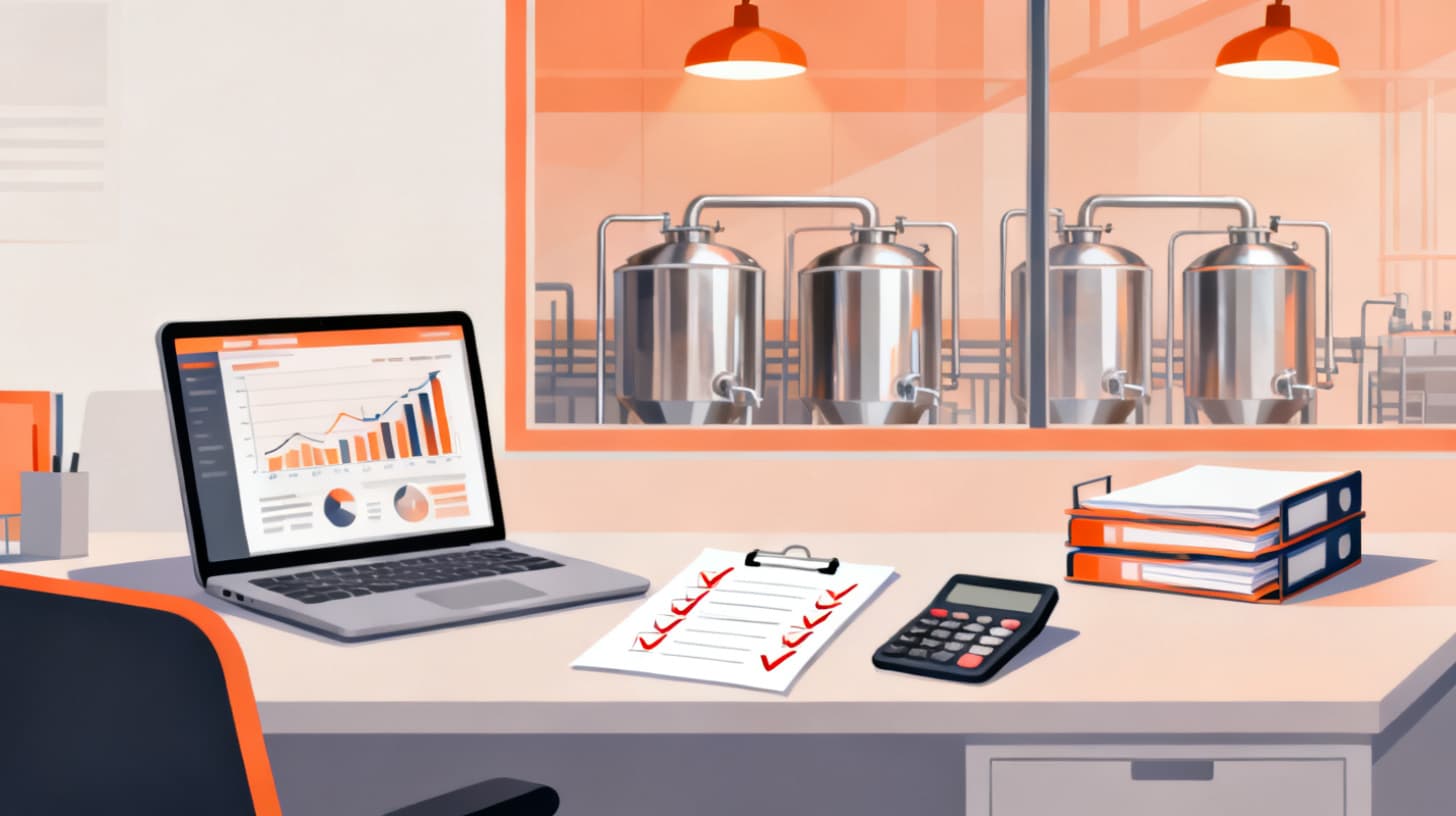
Digital checklists solve this elegantly. When task completion is recorded in a system rather than on a paper sheet that gets coffee-stained and recycled, you create an automatic audit trail. You can see at a glance which batches had every QC checkpoint completed and which ones have gaps. More importantly, your team can see it.
This visibility changes behavior. When brewers know their checklist completion is tracked, they're more likely to actually do the steps rather than check boxes retroactively. It's not about catching people doing wrong things. It's about making it easy to do the right things and harder to skip them.
Practical accountability structures include:
- 1Daily production huddles (5 minutes, standing up) where the shift lead reviews the previous day's checklist completion and flags any missed items or out-of-spec readings
- 2Batch review meetings (weekly, 30 minutes) where the team reviews quality data from the week's batches, identifies trends, and discusses any deviations
- 3Quarterly SOP reviews where each team member "owns" a set of procedures and is responsible for proposing updates based on what they've learned
Train the Why, Not Just the What
The difference between a team that follows SOPs grudgingly and one that follows them by default is understanding. When your cellar crew understands why dissolved oxygen pickup during transfers matters (staling, flavor degradation, shelf life), they don't need to be told to purge the hose with CO2. They just do it because it makes sense.
Build training around three questions for every SOP:
- 1What can go wrong if this step is skipped or done incorrectly?
- 2What does it cost the brewery when that happens? (Lost batches, customer returns, rework time)
- 3How does doing it right make their own job easier or better?
People follow procedures they believe in. Invest the upfront time to explain the reasoning, and you'll spend far less time policing compliance later.
Create Feedback Loops That Actually Work
Your SOPs will need to change. The question is whether updates happen proactively (through feedback) or reactively (after something goes wrong).
Give your team a dead-simple way to suggest SOP changes. This could be a shared document, a suggestion box, or a flag in your production management system. The mechanism matters less than the principle: when someone suggests an improvement and you actually implement it, you've just turned that person into an evangelist for your quality program.
Track SOP revisions with version numbers and dates. When you update a procedure, walk your team through the change at the next huddle. Small, frequent updates keep SOPs alive. Massive overhauls signal that the documents were neglected.
Connecting your quality processes to your broader operational workflows reinforces their importance. When your QC checklists are part of the same system you use to manage purchase orders and vendor relationships, quality becomes woven into operations rather than bolted on as an afterthought.
Your Brewery Quality Program Starter Template
Let's pull everything together into a practical framework you can implement starting now. You don't need to build a comprehensive quality program overnight. Start with the highest-impact areas, build momentum, and expand from there.
Phase 1: Foundation (First Two Weeks)
Focus on three core SOP areas that affect every batch:
- 1CIP and sanitation procedures for your three vessel types. Write one SOP per vessel category (brewhouse, fermenter, brite tank). Create a matching checklist for each.
- 2Brew day procedures covering water treatment through knockout. One SOP, one checklist.
- 3Fermentation monitoring covering gravity tracking, temperature management, and sensory evaluation schedule. One SOP, one checklist.
That gives you six documents total. Have your team review drafts and incorporate their feedback before finalizing.
Phase 2: Expansion (Weeks Three Through Six)
Add SOPs and checklists for:
- Yeast management (harvesting, storage, viability testing, pitch rates)
- Packaging (line setup, dissolved oxygen checks, fill levels, date coding, seam/seal integrity)
- Raw material receiving (checking deliveries against purchase orders, proper storage, lot tracking)
- Chemical safety and handling
Phase 3: Maturity (Ongoing)
Once your core procedures are in place and your team is consistently following them, layer in:
- Sensory evaluation panels with standardized scoresheets
- Trend analysis of quality data (gravity consistency, attenuation, DO levels over time)
- Corrective action procedures for when something goes out of spec
- Supplier qualification records tying ingredient quality to finished beer quality
At each phase, resist the temptation to create more documents than your team can realistically absorb. Three SOPs that people follow are infinitely more valuable than thirty that people ignore.
The best quality control program is the one your team actually uses. Start small, make it practical, build ownership, and iterate.
Building a brewery quality program that works isn't about perfection on day one. It's about creating habits, providing the right tools, and fostering a culture where quality is everyone's responsibility. If you're ready to move your checklists and production tracking out of binders and into a system your whole team can access, start a free trial with BrewPlanner and see how task checklists, batch tracking, and production scheduling come together in one platform.