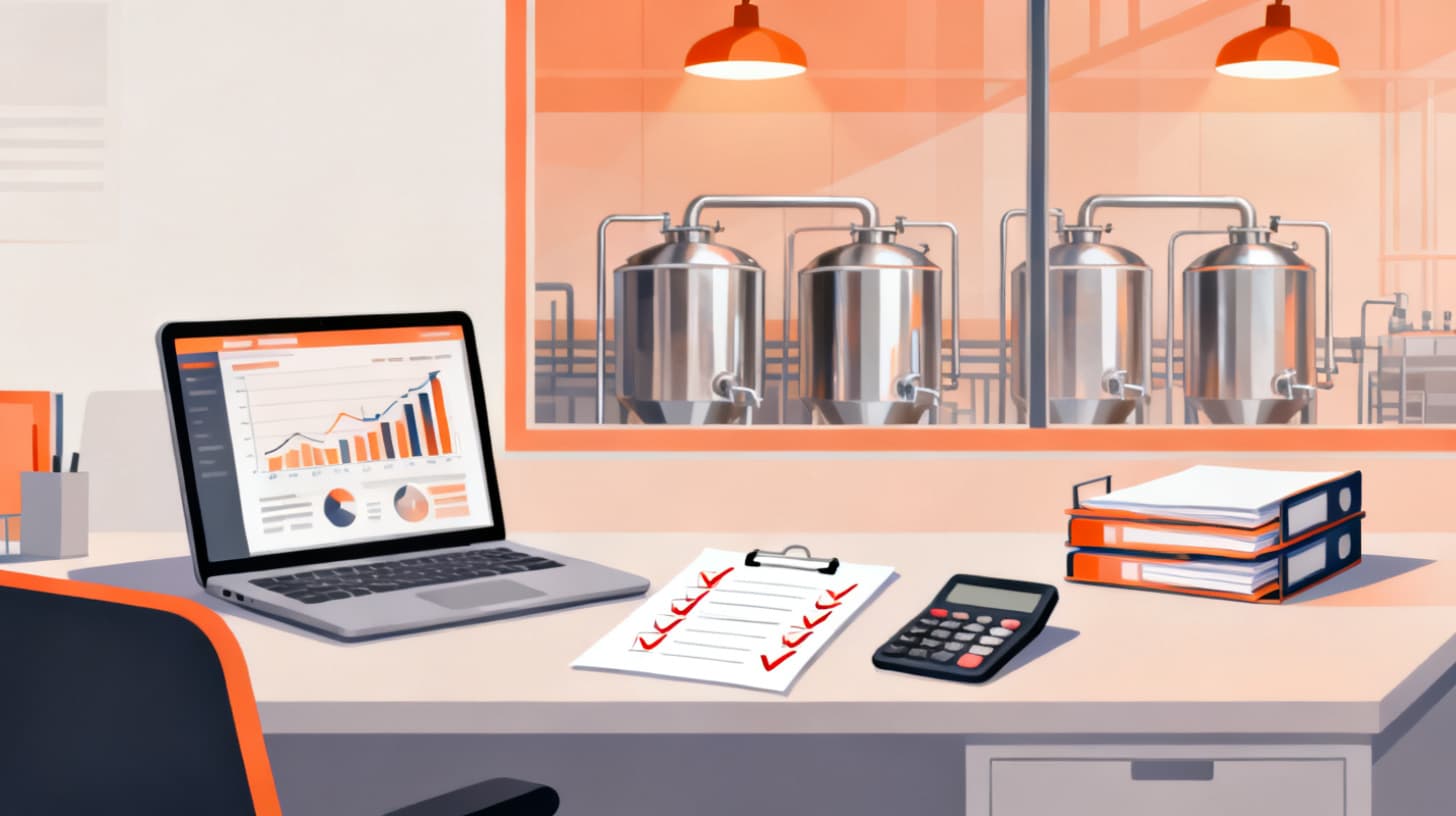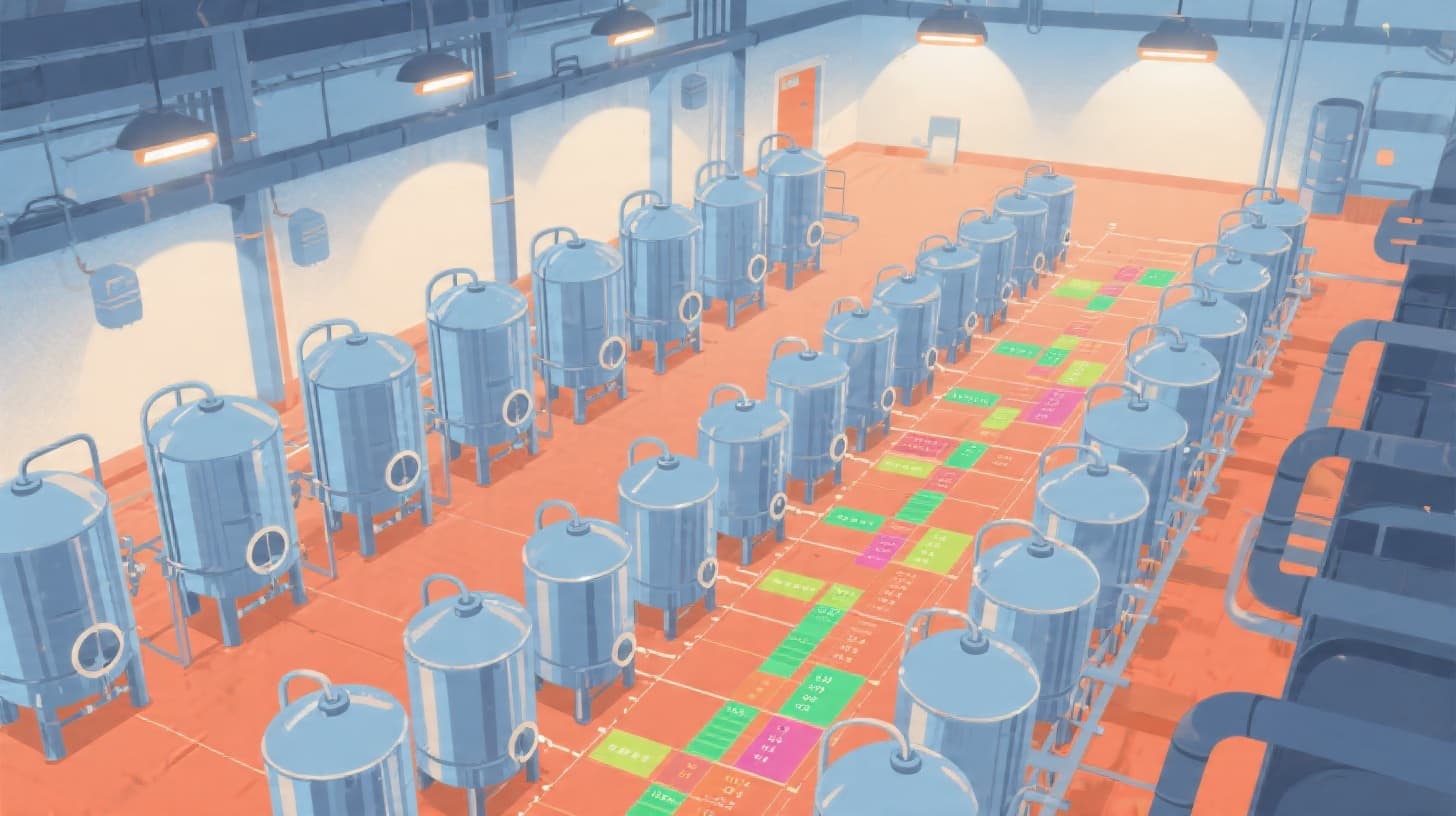
A single fermenter sitting empty for three days might not seem like a big deal. But multiply that by a dozen tanks across a full quarter, and you're looking at thousands of dollars in lost production capacity. For most craft breweries, tanks are the single most expensive asset on the floor, and how well you schedule them determines whether you're running a profitable operation or constantly playing catch-up.
The good news? You don't need more tanks. You need a better schedule. Building a production schedule that truly maximizes tank utilization requires a shift in thinking, from reactive brewing ("what do we need this week?") to proactive capacity planning ("how do we keep every vessel productive without creating bottlenecks?"). Tools like BrewPlanner make this kind of visual, phase-based scheduling possible with drag-and-drop tank assignment across your brewhouse, fermenters, and brite tanks. But before you touch any software, you need to understand the principles behind great scheduling.
This guide walks you through a practical framework for building a production schedule that squeezes maximum value from every tank in your brewery. Whether you're running five fermenters or fifty, these strategies will help you brew more beer, reduce idle time, and eliminate the chaos of overlapping production runs.
Understanding Your Tank Ecosystem and Production Phases
Before you can optimize your schedule, you need a clear picture of what you're working with. Most breweries operate three distinct vessel types, each with different cycle times, cleaning requirements, and constraints. Treating them as one homogeneous group is the first mistake that leads to poor utilization.
Mapping Your Three Tank Phases
Every batch of beer flows through a predictable sequence of vessels. Your brewhouse (BH) handles mashing, lautering, boiling, and whirlpool. This phase is typically the shortest, often just 4 to 8 hours per batch. Your fermentation vessels (FV) are where beer spends the most time, anywhere from 5 days for a simple ale to 30+ days for a lager or barrel-aged specialty. Finally, your brite tanks (BT) handle carbonation, clarification, and packaging preparation, usually occupying 2 to 5 days per batch.
The key insight is that these three phases have wildly different time signatures. Your brewhouse turns over multiple times per week, but your fermenters might hold the same batch for a month. This mismatch is where most scheduling problems originate. If you schedule based solely on brewhouse capacity, you'll quickly run out of fermenter space. If you schedule based on fermenter availability, your brewhouse sits idle.
Calculating Real Cycle Times
Most brewers underestimate their actual tank cycle times because they only count active production days. A fermenter isn't just occupied during fermentation. You need to account for the full cycle:
- Active fermentation: The biological process itself
- Dry hopping or conditioning: Additional processing time in the same vessel
- Crash cooling: Typically 24 to 48 hours
- Transfer time: Moving beer to brite tank, including any settling
- CIP (Clean-in-Place): Cleaning and sanitizing, often 2 to 4 hours
- Turnaround buffer: Time between CIP completion and next fill
When you add these up honestly, a "7-day fermentation" often occupies a tank for 10 to 12 days. Record your actual cycle times for every beer in your portfolio. Track them for at least 10 batches of each recipe to get reliable averages. This data is the foundation of everything that follows.
Auditing Your Current Utilization
With real cycle times in hand, calculate your current tank utilization rate. The formula is straightforward:
Tank Utilization (%) = (Total Occupied Tank-Days / Total Available Tank-Days) × 100
For example, if you have 6 fermenters and track a 30-day period, you have 180 available tank-days. If your fermenters collectively held beer for 126 of those days, your utilization rate is 70%. Industry benchmarks suggest that well-run craft breweries achieve 75% to 85% fermenter utilization. Below 70%, you have significant room to brew more without buying new equipment. Above 85%, you're likely running tight enough that any delay cascades through the entire schedule.
Don't just calculate a single number. Break utilization down by individual tank, by beer style, and by phase. You might discover that one fermenter is consistently underused because it's an odd size that doesn't match your brewhouse batch volume, or that your brite tanks are the real bottleneck even though you assumed it was fermentation. Tracking volumes across every vessel, as described in this guide to brewery tank management, gives you the granular visibility you need.
Building Your Schedule From Demand Backward
Many brewers build schedules forward: "We can brew on Monday and Wednesday, so let's fill fermenters on those days." This approach ignores the most important variable, which is when beer actually needs to be ready. Flipping your perspective and scheduling backward from demand dates produces dramatically better results.
Starting With Packaging and Delivery Dates
Begin with your commitments. When does beer need to be in kegs, cans, or bottles? Work backward from those dates through each production phase:
- 1Packaging date (the hard deadline)
- 2Brite tank fill date = Packaging date minus BT residence time
- 3Transfer date = BT fill date (this tells you when a fermenter frees up)
- 4Brew date = Transfer date minus fermentation cycle time
- 5Brewhouse availability = Brew date (confirm your BH is open)
This backward approach immediately reveals conflicts. Maybe two batches need to transfer to brite on the same day, but you only have one brite tank. Or maybe three brews need to happen in a single week when your brewhouse can realistically handle two. These conflicts are much easier to resolve during planning than during production.
Here's a concrete example. Say you need 30 barrels of IPA packaged on March 20. Your IPA spends 3 days in the brite tank, 10 days in the fermenter (including dry hop and crash cool), and 1 day brewing. Working backward:
- Brite tank needed: March 17 to 20
- Fermenter needed: March 7 to 17
- Brew day: March 7
- Brewhouse needed: March 7
Now do this for every batch you plan to produce in the period. Layer them on a visual timeline, and patterns emerge.
Staggering Brews to Prevent Phase Collisions
The most common scheduling mistake is clustering brew days together without considering downstream effects. If you brew three batches on Monday, Tuesday, and Wednesday, those three batches will all finish fermentation around the same time and all need brite tank space within a narrow window.
Instead, stagger your brews based on fermentation length. If you brew a 7-day ale on Monday and a 14-day lager on Tuesday, the ale finishes on the following Monday while the lager finishes two weeks after brew day. These staggered completion dates spread the load on your brite tanks and packaging schedule.
A practical rule of thumb: sort your beer portfolio by fermentation cycle time and alternate between short-cycle and long-cycle beers throughout the week. This creates a natural rhythm where fermenters free up at different intervals rather than all at once.
Using Schedule Drafts Before Committing
One of the most powerful scheduling practices is maintaining a draft version of your schedule that you can adjust before it goes live. This lets you play "what if" scenarios. What if you move that stout brew from Wednesday to Friday? Does it free up a fermenter for the double IPA that needs to start sooner?
BrewPlanner's feature set includes schedule draft functionality that lets you prepare changes and evaluate their impact before publishing to the production dashboard. This prevents the chaos that comes from making real-time changes that your team might already be acting on. Draft, review, then publish. It's a small workflow change that eliminates a huge category of scheduling errors.
Advanced Strategies for Pushing Utilization Higher
Once you have the basics in place, a few advanced techniques can push your utilization from good to exceptional. These strategies require more planning effort upfront but pay dividends over months of production.
Right-Sizing Batches to Tank Volumes
Nothing wastes tank capacity like filling a 30-barrel fermenter with a 15-barrel batch. Yet many breweries do this regularly for specialty or seasonal beers. Audit your recipes against your tank sizes and look for mismatches.
If you have a mix of tank sizes (say, four 30-barrel and two 15-barrel fermenters), assign recipes deliberately. Your flagship IPA that sells 30 barrels a week goes in the big tanks. Your experimental sour that you only need 10 barrels of goes in a smaller vessel. If you don't have small tanks, consider whether you can double-batch a smaller recipe to fill the tank completely, or whether it makes more sense to collaborate with another brewery for small runs.
Document the optimal tank assignment for each recipe in your portfolio. Over time, this mapping becomes second nature, but having it written down prevents suboptimal decisions during busy periods when people are tempted to just use whatever's available.
Overlapping Phases to Eliminate Dead Time
Dead time, the hours between when one batch leaves a tank and the next batch enters, is the silent killer of utilization. In many breweries, a fermenter sits empty for 24 to 48 hours simply because nobody coordinated the CIP schedule with the next brew.
Tighten this gap by scheduling your CIP immediately after transfer and timing your next brew to fill the fermenter within hours of CIP completion. This requires coordination between your cellar team and your brewers, but the payoff is substantial. Cutting just 12 hours of dead time per tank turnover across 6 fermenters over a month can recover the equivalent of two to three additional production days.
Create a standard operating procedure for tank turnovers that specifies:
- Transfer to brite completed and confirmed
- CIP chemicals prepped before transfer begins
- CIP started within 1 hour of transfer completion
- CIP verification and sign-off
- Next batch wort ready to pitch within 2 hours of CIP completion
This checklist approach, built into your brewing workflow, turns fast turnovers from aspirational goals into standard practice.
Seasonal Demand Smoothing
Many breweries experience dramatic swings in demand between summer and winter. If you only brew to current demand, your tanks sit idle during slow periods. Instead, use slow periods to build inventory of beers that hold up well, like lagers, stouts, and barrel-aged specialties. This keeps utilization high year-round and ensures you have stock when demand spikes.
The key is knowing your storage limits. If you don't have cold storage for packaged beer, you're limited in how much you can pre-build. But if you can package and warehouse even moderately, producing ahead of demand curves is one of the most effective utilization strategies available.
For a deeper look at preventing the specific bottlenecks that derail these advanced strategies, check out this piece on brewery tank scheduling that prevents bottlenecks.
Putting It All Together With a Repeatable Process
Strategies are only useful if they translate into a consistent, repeatable workflow. Here's how to turn everything above into a production scheduling process you can run every week or every month, depending on your brewery's cadence.
The Weekly Scheduling Workflow
Set aside a dedicated block of time each week for production scheduling. For most breweries, 60 to 90 minutes is sufficient. Use this structure:
- 1Review actual vs. planned: Compare last week's schedule to what actually happened. Did any fermentations run long? Did a tank turn over late? Track variances so you can adjust your cycle time estimates over time.
- 2Confirm packaging commitments: Lock in the upcoming two weeks of packaging dates based on sales orders, distributor commitments, and taproom projections.
- 3Work backward to assign tank slots: Using the backward-scheduling method described above, assign each batch to specific fermenters and brite tanks. Look for conflicts and resolve them by shifting brew days or swapping tank assignments.
- 4Check brewhouse capacity: Confirm that your brew day schedule is realistic given staffing, ingredient availability, and maintenance windows.
- 5Publish the schedule: Push the finalized schedule to your team so everyone, from brewers to cellar workers to packaging staff, knows what's happening and when.
This process becomes faster each week as you build muscle memory around your brewery's rhythms. Within a month, most teams can complete it in under an hour.
Tracking and Improving Over Time
The best scheduling systems get better with data. Track these metrics monthly:
MetricTarget RangeWhy It MattersFermenter utilization rate75-85%Core measure of capacity usageAverage dead time per turnover< 8 hoursMeasures turnaround efficiencySchedule adherence rate> 90%Shows planning accuracyBatch cycle time variance< 10%Indicates process consistencyBrite tank queue time< 24 hoursReveals downstream bottlenecks
When a metric trends in the wrong direction, investigate the root cause. Maybe a new recipe has unpredictable fermentation times. Maybe a piece of equipment needs maintenance and is causing delays. The data tells you where to focus.
Making the Shift to Software
Spreadsheets work for very small operations, but they break down quickly as you add tanks, recipes, and complexity. A visual scheduling grid where you can drag and drop batches across tank timelines transforms how you plan. You can see conflicts at a glance, experiment with different arrangements, and share the schedule with your entire team in real time.
If you're still managing your production schedule in a spreadsheet or on a whiteboard, take a look at BrewPlanner's pricing options to see how purpose-built scheduling tools compare to the cost of even one underutilized fermenter per month. For most breweries, the math is overwhelmingly in favor of software.
Maximizing tank utilization isn't about working harder or cramming more brews into an already hectic week. It's about working smarter, with accurate cycle times, backward-scheduled timelines, staggered brew days, and tight turnovers. The breweries that master this consistently outproduce competitors with the same equipment, turning their existing tanks into a genuine competitive advantage.
Start with an honest audit of your current utilization. Pick one strategy from this guide and implement it over the next two weeks. Measure the impact, adjust, and add another. Small, compounding improvements in scheduling discipline will transform your production capacity without a single new tank purchase.