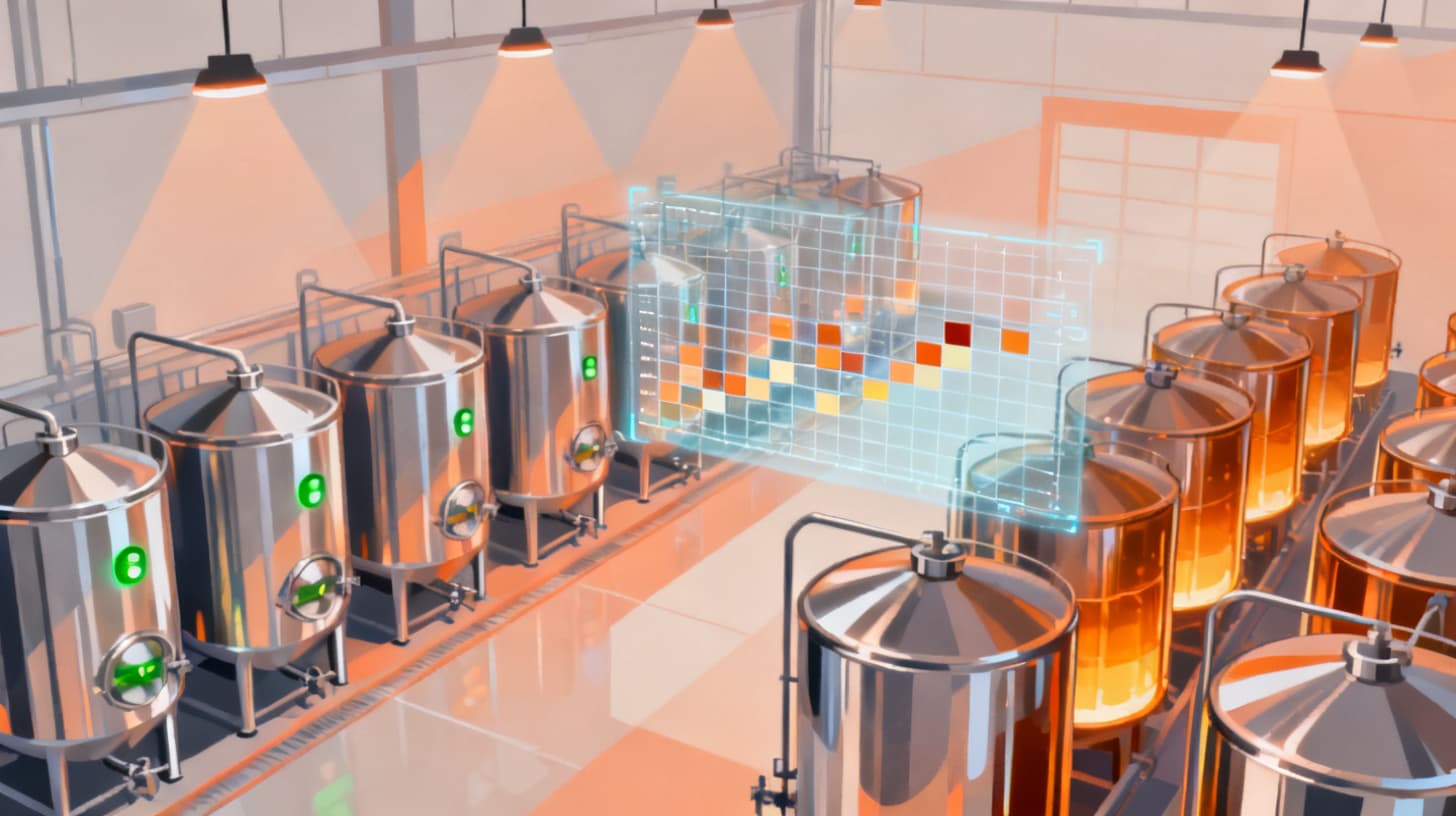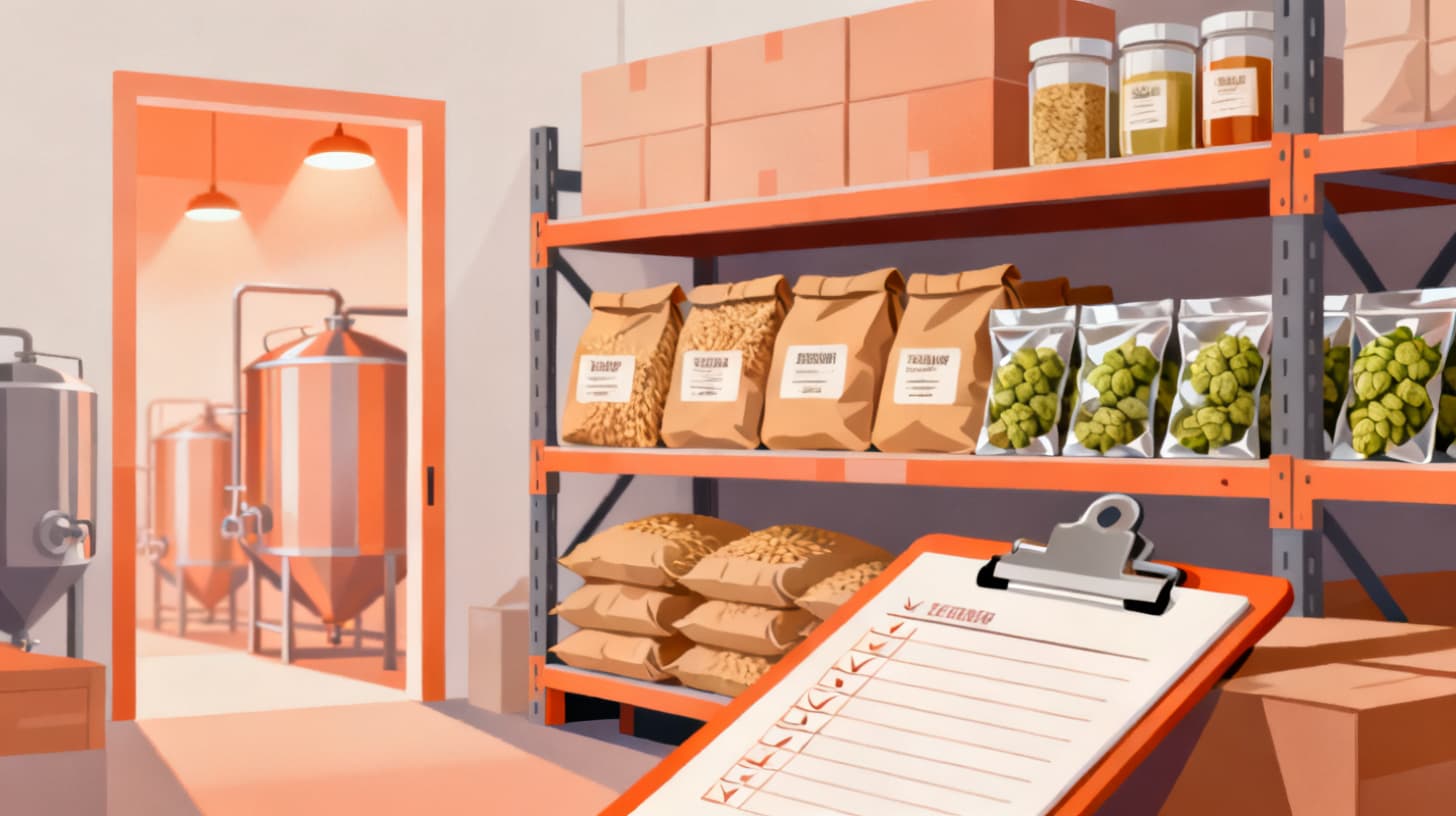
A single missing ingredient can shut down an entire brew day. Maybe it's a specialty hop that went out of stock at your supplier, or a yeast strain that needed a starter two days ago. Whatever the cause, the result is always the same: idle tanks, wasted labor, missed delivery dates, and frustrated customers.
The frustrating part? Most stockouts are completely preventable. They don't happen because breweries lack ingredients. They happen because breweries lack a system that connects what they plan to brew with what they actually have on hand. That system starts with a well-built Bill of Materials (BOM) and extends into Material Requirements Planning (MRP) calculations that tell you exactly what to order and when.
This guide walks you through how to set up BOMs for every beer in your portfolio, run MRP calculations against your production schedule, and build a purchasing workflow that keeps raw materials flowing without overstocking your warehouse. If you're running a growing brewery and want to stop firefighting ingredient shortages, this is the playbook. And if you want to see how brewery management software handles this entire workflow from recipe to purchase order, you'll find BrewPlanner covers every step we outline here.
Building a Bill of Materials That Actually Works
A Bill of Materials is the bridge between your recipes and your inventory. Think of it as a master ingredient list for each beer, but more precise than what lives in your brewmaster's head or on a scribbled recipe card. A proper BOM captures every raw material, the exact quantity required per batch, the unit of measure, and the supplier information for each item.
The distinction between a recipe and a BOM matters. Your recipe tells you how to brew. Your BOM tells you what it costs to brew and what you need to have on hand. Without that second layer of data, your inventory system is flying blind.
Start with Your Core Beers
Don't try to document every seasonal, collaboration, and pilot batch on day one. Start with the beers you brew most frequently. For most breweries, that's three to five flagship styles that represent 70-80% of production volume.
For each beer, document every raw material that goes into a single batch at your standard batch size. That means:
- Base malts and specialty grains with weights in pounds or kilograms
- Hops broken down by addition (bittering, flavor, aroma, dry hop) with weights in ounces or grams
- Yeast with the pitch rate and pack count or volume of slurry
- Water treatment additions like gypsum, calcium chloride, lactic acid
- Fining agents such as Whirlfloc, gelatin, or biofine
- Packaging materials if you track those in the same system (crowns, labels, can lids, six-pack carriers)
The level of detail matters here. A BOM that says "hops: 15 lbs" isn't useful for purchasing. A BOM that says "Citra T90 pellets: 8 lbs at 60 min, Mosaic T90 pellets: 4 lbs at flameout, Citra T90 pellets: 3 lbs dry hop day 4" gives you the granularity you need to order the right varieties in the right quantities.
Account for Loss and Variability
Here's where many breweries stumble. Your theoretical grain usage and your actual grain usage are never identical. You lose extract to spent grain, you lose wort to trub, you lose beer to yeast and hop matter in the fermenter, and you lose more to transfers and packaging.
Build a waste factor into each BOM line item. A common approach is adding 5-10% to grain quantities, 3-5% to hop quantities, and accounting for one extra yeast pack per batch as a buffer. These percentages will vary based on your specific system, so track your actual usage over several batches and adjust.
The goal is a BOM that reflects reality, not theory. When your BOM says you need 420 pounds of Pale Ale malt for a batch, and you actually use 415-425 pounds, your MRP calculations downstream will be accurate enough to prevent both stockouts and excess inventory.
If you've already started building BOMs and want to connect that data to cost analysis, the guide on how to track brewing costs and calculate true cost per batch walks through that next step. Once your BOM quantities are dialed in, layering in cost data per ingredient gives you real cost-per-barrel figures that feed pricing decisions.
Link Every BOM Item to Your Inventory
A BOM that exists in a spreadsheet disconnected from your inventory system creates extra manual work and introduces errors. Each line item in your BOM should map directly to a specific item in your inventory, using the same name, unit of measure, and supplier. This linkage is what makes MRP calculations possible.
When BOM items and inventory items share a common identifier, the math becomes straightforward: production schedule times BOM quantities equals gross material requirements, minus current stock on hand, equals what you need to order. Without that linkage, someone has to manually cross-reference recipes against stock levels, and that person will eventually miss something.
For a detailed walkthrough on connecting recipes to inventory items, the guide on how to build a beer recipe bill of materials linked to inventory covers the setup process step by step.
Running MRP Calculations Against Your Production Schedule
With accurate BOMs in place and linked to your inventory, you have the foundation for Material Requirements Planning. MRP is a straightforward concept that delivers enormous value: it looks at what you plan to brew, calculates the total raw materials required, compares that to what you currently have in stock, factors in what's already on order from suppliers, and tells you exactly what you need to purchase and when.
The magic of MRP isn't in the math. It's in the automation. Instead of your head brewer or production manager manually checking stock levels before every brew day, the system does it continuously and flags shortfalls before they become emergencies.
The Three Inputs MRP Needs
Every MRP calculation depends on three data points working together:
- 1The production schedule. This is the list of beers you plan to brew over a defined time horizon, typically two to six weeks out. Each scheduled brew ties to a specific beer style, batch size, and planned brew date. The more accurate and further out your schedule extends, the more lead time MRP gives you for purchasing.
- 2Bill of Materials for each scheduled beer. The BOM tells MRP exactly what raw materials each brew requires. When you schedule three batches of your IPA and two batches of your lager, MRP multiplies the BOM quantities by the batch count to get gross requirements for every ingredient.
- 3Current inventory levels. This includes what's physically on your shelves in every storage location, plus any open purchase orders that haven't been received yet. MRP subtracts available stock (and incoming orders) from gross requirements to calculate net requirements, which is the actual shortage you need to fill.
Here's a concrete example. Suppose your production schedule shows five brews over the next three weeks:
Brew DateBeerBatch SizeWeek 1Flagship IPA15 BBLWeek 1Hefeweizen15 BBLWeek 2Flagship IPA15 BBLWeek 2Pale Ale15 BBLWeek 3Flagship IPA15 BBL
Your Flagship IPA BOM calls for 12 pounds of Citra hops per batch. Three batches means 36 pounds of Citra needed. You have 18 pounds in stock and a purchase order for 10 pounds arriving next week. MRP calculates: 36 (gross) minus 18 (on hand) minus 10 (on order) equals 8 pounds net requirement. You need to order at least 8 more pounds of Citra, and you need it before the Week 3 brew date.
That's MRP in its simplest form. Scale it across every ingredient in every BOM for every scheduled brew, and you have a complete purchasing picture.
Time-Phasing and Supplier Lead Times
Knowing what to order is only half the problem. Knowing when to order is equally important. This is where lead times come in.
Every raw material has a lead time, the gap between when you place an order and when it arrives at your dock. Domestic base malts might take 3-5 business days. Specialty hops from overseas could take 2-3 weeks. Liquid yeast cultures often need 5-7 days, sometimes longer for less common strains.
When you encode lead times into your system alongside BOMs and inventory levels, MRP can back-calculate order dates. If you need 8 pounds of Citra for a Week 3 brew and your hop supplier has a 5-day lead time, MRP tells you to place that order no later than the middle of Week 2.
This time-phased view transforms purchasing from reactive to proactive. Instead of discovering on Tuesday that you're short on hops for Thursday's brew, you're placing orders two weeks ahead with confidence that they'll arrive on time.
Your production schedule feeds directly into these calculations, which is why connecting raw material planning to your brewery production schedule and tank utilization creates a closed-loop system. When a brew moves on the schedule, the MRP output adjusts automatically.
From MRP Output to Purchase Orders and Reorder Alerts
MRP calculations generate a list of materials you need to buy. But a list sitting in a report doesn't prevent stockouts. You need a purchasing workflow that converts MRP recommendations into actual purchase orders, tracks their status, and alerts you when something falls behind.
Setting Reorder Points and Safety Stock
MRP handles planned demand beautifully, but breweries also deal with unplanned demand. A restaurant chain doubles their keg order. A festival booking comes in last minute. A batch gets dumped due to contamination and needs to be re-brewed immediately.
Safety stock is your buffer against these surprises. For each raw material, set a minimum quantity threshold that represents the buffer you want to maintain above and beyond planned requirements. When your actual stock drops to or below that threshold, the system triggers a reorder alert regardless of what the production schedule says.
How much safety stock to carry depends on several factors:
- Ingredient criticality. If running out of a specific hop means you can't brew your top-selling beer, carry more safety stock for that hop.
- Supplier reliability. If a supplier frequently ships late or short, increase your buffer.
- Lead time variability. Ingredients with unpredictable lead times need larger buffers than those you can get in two days from a local maltster.
- Storage constraints and shelf life. Hops degrade over time even when cold-stored. Liquid yeast has limited viability. Don't buffer more than you can reasonably use before quality declines.
A practical starting point: set safety stock at one batch worth of each ingredient for your highest-volume beers, and half a batch for lower-volume styles. Adjust from there based on actual experience.
Converting MRP Results into Purchase Orders
The workflow from MRP calculation to purchase order should be as streamlined as possible. Here's what a clean process looks like:
- 1Review the MRP output. Look at net requirements for the upcoming planning horizon. Group requirements by supplier so you can consolidate orders and potentially hit volume discounts or minimum order thresholds.
- 2Create purchase orders by vendor. Each PO should list the items needed, quantities, expected delivery dates, and agreed pricing. Consolidating items per supplier reduces freight costs and administrative overhead.
- 3Submit and track. Once sent to the supplier, the PO status should move from PENDING to ORDERED. The expected quantities should show up as "on order" in your inventory calculations so the next MRP run accounts for them.
- 4Receive against the PO. When materials arrive, receive them against the original purchase order line by line. This updates your on-hand inventory, closes out the PO (or partially receives if a shipment is split), and gives you receiving data you can use to evaluate supplier performance.
- 5Handle discrepancies. If a supplier shorts you, delivers late, or sends the wrong item, your system should flag the PO as LATE or partially received. This visibility lets you adjust your production schedule before the gap causes a brew day cancellation.
Accurate record-keeping through this entire lifecycle also supports federal compliance. The TTB requires breweries to maintain detailed records of materials used in production, and a clean BOM-to-PO-to-receiving trail gives you auditable documentation without extra effort.
Closing the Loop with Actual Usage Tracking
The final piece of the puzzle is comparing what your BOM predicted against what you actually used. After every brew day, record actual ingredient quantities consumed. Over time, this data reveals patterns:
- Are your BOMs consistently overestimating grain usage? Tighten the waste factor.
- Are you burning through a particular hop variety faster than planned? Maybe your dry hop process loses more than you accounted for.
- Is yeast viability lower than expected, requiring extra packs? Adjust the BOM or explore yeast management improvements.
This feedback loop continuously improves BOM accuracy, which improves MRP accuracy, which improves purchasing accuracy. The result is fewer stockouts, less waste from over-ordering, and a more predictable cost structure for every barrel you produce.
Putting It All Together for Your Brewery
Preventing raw material stockouts isn't about working harder. It's about connecting the data you already have, recipes, inventory counts, production plans, and supplier information, into a system that does the math for you.
Here's a quick checklist to get started:
- Build BOMs for your top 3-5 beers with exact quantities, waste factors, and supplier info
- Link every BOM line item to a corresponding inventory item with matching units
- Enter current stock levels and open purchase orders into your system
- Document supplier lead times for every raw material category
- Set safety stock minimums for critical ingredients
- Run your first MRP calculation against your next two weeks of scheduled brews
- Create purchase orders from the MRP output and submit to suppliers
- After each brew, record actual usage and compare to BOM predictions
- Adjust BOMs quarterly based on actual consumption data
The difference between a brewery that scrambles for ingredients and one that operates smoothly isn't luck. It's a system. BOMs give you the recipe-to-inventory linkage. MRP gives you the schedule-to-purchasing intelligence. And a good purchasing workflow turns those calculations into materials on your dock before you need them.
If you're ready to stop guessing and start planning, BrewPlanner's brewery management software connects your BOMs, inventory, production schedule, vendor catalogs, and purchase orders into one system that handles MRP calculations and reorder alerts automatically. Set it up once, and spend your energy where it belongs: making great beer.