Every fermenter sitting empty is money draining from your brewery. Not in an abstract, theoretical sense, but in real, measurable dollars. If you operate ten fermenters and each one sits idle for just two extra days per batch cycle, that adds up to over 240 lost production days per year. Depending on your batch size and margin, that could mean six figures in unrealized revenue.
The good news? Tank turnover rate is one of the most controllable metrics in your entire operation. Unlike raw material costs or taproom foot traffic, you have direct influence over how quickly beer moves through your vessels. The challenge is knowing exactly where your time goes and having a system to optimize it.
This guide walks you through the math behind tank turnover rates, shows you how to identify and eliminate idle time, and gives you a practical framework for squeezing more production out of the tanks you already own. If you're ready to move beyond spreadsheets and manual tracking, tools like BrewPlanner can automate much of this with visual scheduling dashboards that show exactly where every vessel stands.
Let's get into the numbers.
Understanding Tank Turnover Rate and Why It Matters Financially
Tank turnover rate measures how many times a single vessel completes a full production cycle within a given period. It sounds simple, but the implications ripple across your entire business, from production volume and cash flow to staffing decisions and expansion planning.
The Core Formula
The basic calculation is straightforward:
Tank Turnover Rate = Total Batch Cycles Completed / Number of Available Tank-Days
But let's make this more practical. Say you have a 30 BBL fermenter and you want to know its monthly turnover rate:
- 1Count how many complete batch cycles that fermenter handled in a month
- 2Divide by the theoretical maximum number of cycles possible
To find the theoretical maximum, you need to know your minimum cycle time, which is the fastest a batch can realistically move through that vessel.
Here's a worked example:
MetricValueFermenter capacity30 BBLAverage fermentation time14 daysCIP/turnaround time1 dayTotal cycle time15 daysDays in month30Theoretical max cycles2.0Actual cycles completed1.5Turnover efficiency75%
That 25% gap represents 7.5 idle days. At a gross margin of $80 per barrel on a 30 BBL batch, those lost days cost you $1,200 in unrealized margin from that single tank in a single month.
Why Utilization Beats Expansion
Brewery owners often think about adding tanks when they hit capacity constraints. But a new 30 BBL fermenter, including glycol, fittings, and installation, can run $15,000 to $40,000 depending on your setup. Before making that investment, it's worth asking: are your existing tanks running at their potential?
Most craft breweries operate between 60% and 75% tank utilization. Getting to 85% or higher from a baseline of 65% effectively gives you the equivalent output of adding another tank to your cellar, without spending a dime on hardware.
The financial case becomes even clearer when you factor fermenter time into your per-batch cost calculations. Every day a batch occupies a tank adds to its true cost. Understanding this relationship is a game-changer for pricing decisions, which is why calculating your true per-batch COGS should go hand in hand with optimizing turnover rates.
Breaking Down Total Cycle Time
To improve turnover, you first need to understand where time actually goes within each cycle. A typical fermenter cycle includes:
- Pre-fill preparation: CIP, sanitization, pre-chill (0.5 to 1 day)
- Fill/transfer in: Wort transfer from brewhouse (same day as brew)
- Active fermentation: Primary fermentation (4 to 14 days depending on style)
- Conditioning/dry hopping: Additional vessel time for flavor development (0 to 7 days)
- Crash cooling: Dropping temperature for clarity (1 to 3 days)
- Transfer out: Moving to brite tank or packaging (0.5 day)
- Post-transfer CIP: Cleaning before next use (0.5 to 1 day)
The total adds up fast. A straightforward ale might occupy a fermenter for 10 to 12 days. A lager or heavily dry-hopped IPA could sit for 21 to 28 days. Tracking these individual segments is where you start finding the hidden idle time that kills your turnover rate.
Identifying and Eliminating Hidden Idle Time
Idle time isn't always obvious. It's rarely a tank sitting visibly empty for a week. More often, it's scattered across dozens of small inefficiencies: a batch that sat an extra day before transfer because packaging wasn't ready, a CIP that got delayed because someone was busy with another task, or a fermenter that finished on Friday afternoon but didn't get emptied until Monday morning.
These micro-gaps are invisible on a monthly P&L, but they compound dramatically across your entire tank farm over a year.
Audit Your Current State
Before optimizing anything, you need baseline data. For every tank, track the following over at least 8 to 12 complete batch cycles:
- Date and time wort enters the vessel
- Date fermentation reaches terminal gravity
- Date of any dry hop or conditioning additions
- Date crash cooling begins
- Date and time beer transfers out
- Date and time CIP completes
- Date and time next batch fills the vessel
The gap between "CIP completes" and "next batch fills" is your true idle time. Everything else is productive cycle time (even if some of that productive time can be shortened).
Most breweries that do this exercise for the first time discover 2 to 5 days of idle time per cycle that they didn't realize existed. Multiply that across your tank count and annual batch volume, and the lost capacity is staggering.
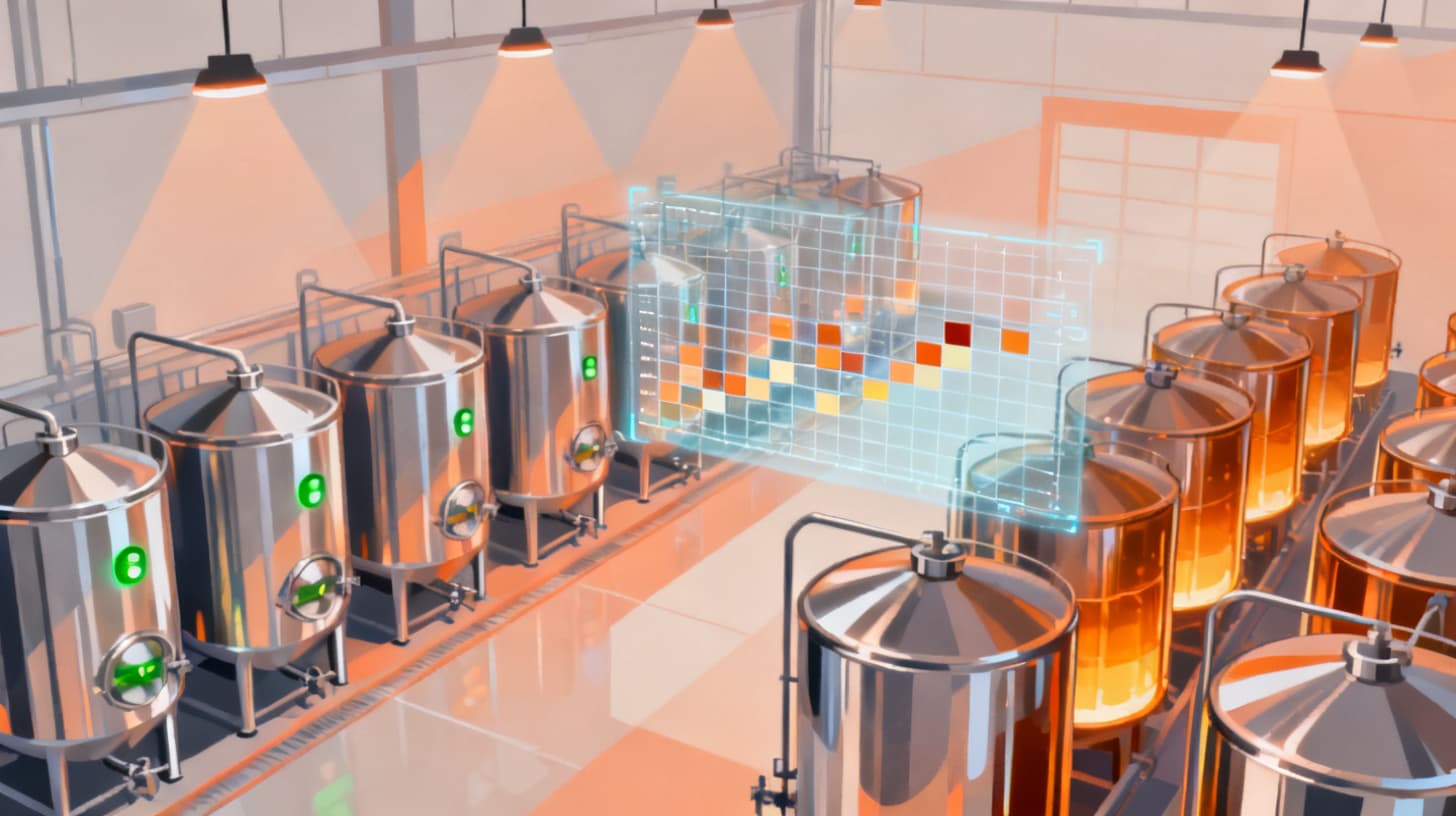
Visual tank scheduling tools make this audit much easier. When you can see every vessel's timeline laid out on a tank management dashboard, gaps become immediately visible instead of hiding in log sheets.
The Five Most Common Sources of Idle Time
After auditing dozens of brewery workflows, the same culprits show up repeatedly:
1. Scheduling misalignment between brewhouse and cellar. Your brewhouse produces wort on its own schedule, but if there's no fermenter ready to receive it, you either delay the brew or rush a transfer. Both create downstream problems.
2. Waiting for lab results. If you're checking final gravity or running VDK tests but only doing so once daily, you might miss the optimal transfer window by 12 to 18 hours every cycle.
3. Brite tank bottlenecks. Beer is ready to leave the fermenter, but there's no brite tank available. The fermenter becomes an expensive holding vessel.
4. Weekend and shift gaps. Many breweries don't transfer or package on weekends. If a batch finishes Thursday evening, it might sit until Monday. That's three days of idle time per cycle.
5. CIP scheduling conflicts. Only one CIP circuit, but multiple tanks need cleaning? Tanks queue up waiting for their turn.
Each of these problems has a solution, but only if you can see them happening in real time. This is where scheduling systems that prevent bottlenecks pay for themselves many times over.
Practical Fixes You Can Implement This Week
You don't need to overhaul your entire operation to see improvements. Start with these high-impact changes:
Stagger your brew schedule to match fermenter availability. Instead of brewing Monday through Friday and hoping tanks are free, work backwards from when fermenters will be empty. If FV-3 finishes on Wednesday, schedule the next brew for that vessel on Thursday morning.
Test gravity twice daily during the final days of fermentation. A simple morning and afternoon gravity check means you catch terminal gravity within hours instead of losing a full day.
Pre-schedule CIP immediately after every transfer. Don't let cleaning become an afterthought. The moment beer leaves a fermenter, the CIP should already be on the calendar.
Build a 48-hour rolling transfer plan. Every morning, your cellar team should know exactly which tanks are transferring out in the next two days, which ones need CIP, and which ones are receiving new wort.
Building a Tank Scheduling System That Maximizes Throughput
Once you've identified your idle time sources and implemented quick fixes, the next step is building a systematic approach to scheduling that prevents these problems from recurring. This is where the operational discipline meets the planning tools.
Map Your Beer Portfolio to Tank Time
Not all beers are equal when it comes to tank utilization. Start by categorizing every beer in your portfolio by total fermenter days:
Beer StyleFermentationConditioningCrashCIPTotal CycleSession Pale Ale5 days0 days1 day1 day7 daysWest Coast IPA7 days2 days (dry hop)2 days1 day12 daysHazy IPA7 days3 days (dry hop)1 day1 day12 daysAmber Lager14 days7 days2 days1 day24 daysImperial Stout14 days14 days3 days1 day32 days
This table immediately reveals a critical insight: one batch of Imperial Stout occupies a fermenter for the same amount of time as 4.5 batches of Session Pale Ale. If both beers generate similar gross margin per barrel, the pale ale generates over four times the return per fermenter-day.
This doesn't mean you should stop making imperial stouts. It means you should be intentional about when and how you schedule them. Dedicating your highest-capacity fermenter to long-cycle beers while keeping smaller, faster-turning vessels on quick-cycle styles is a common strategy that balances portfolio variety with utilization targets.
The Cascade Scheduling Method
The most effective scheduling approach for multi-tank breweries is cascade scheduling, where you stagger batch starts so that transfers, CIPs, and fills happen in a predictable, non-overlapping sequence.
Here's how it works with a four-fermenter setup:
- 1Day 1: Brew into FV-1
- 2Day 3: Brew into FV-2
- 3Day 5: Brew into FV-3
- 4Day 7: Brew into FV-4
- 5Day 8: FV-1 is at day 7 of fermentation (nearing completion for a quick-turn ale)
- 6Day 9: Transfer FV-1 to brite, CIP FV-1
- 7Day 10: Brew into FV-1 again
By spacing your brews by two days instead of brewing back to back, you create natural windows for transfers and cleaning that don't compete with each other for labor or equipment.
The cascade approach also smooths out your ingredient consumption, which ties directly into material planning. Running out of a key hop variety because you brewed four batches in two days is a preventable problem. Using bill of materials and MRP planning ensures your ingredients are ready when your tanks are.
Setting Utilization Targets by Tank Type
Different vessel types should have different utilization targets:
Tank TypeTarget UtilizationWhyBrewhouse85-95%Short cycle time, high throughput potentialFermenter80-90%Longest cycle, most impactful to optimizeBrite Tank70-85%Needs buffer capacity to avoid blocking fermenters
Notice that brite tank targets are intentionally lower. If your brite tanks are at 95% utilization, you have zero buffer when things don't go perfectly. A packaging delay, a failed carbonation check, or a surprise keg order means a fermenter gets blocked waiting for brite space. Keeping 15% to 30% brite tank availability is a strategic choice that actually improves overall throughput.
Measuring Progress and Scaling Your Optimization
Improving tank turnover isn't a one-time project. It's an ongoing discipline that gets better as you collect more data and refine your processes.
Key Metrics to Track Monthly
Build a simple dashboard (even a spreadsheet works to start) that tracks these numbers for each tank every month:
- Turnover rate: Actual cycles divided by theoretical maximum
- Average idle days per cycle: Time between CIP completion and next fill
- Average total cycle days: Broken down by beer style
- Throughput in BBL: Total volume processed through each vessel
- Bottleneck frequency: How often a fermenter was blocked by a downstream vessel
Track these over time and you'll see patterns. Maybe your utilization dips every time you brew a seasonal lager, or perhaps one specific fermenter consistently has longer idle times because of its position in your cellar (farther from the brewhouse, harder to reach for transfers).
The Compound Effect of Small Improvements
Let's put some numbers to what incremental improvement looks like for a 10-fermenter brewery running 30 BBL vessels:
ScenarioAvg Cycle DaysAnnual Batches per FVTotal Annual BatchesAnnual BBL OutputCurrent (70% utilization)17 days21.52156,450Improved (80% utilization)14.5 days25.22527,560Optimized (88% utilization)13 days28.12818,430
Going from 70% to 88% utilization adds 66 batches per year, producing an extra 1,980 BBL. At a conservative gross margin of $80 per barrel, that's $158,400 in additional annual margin from the same equipment. No new tanks, no expansion, no additional capital expenditure.
That kind of improvement doesn't happen overnight. But cutting 2.5 days from your average cycle over the course of a few months of focused effort is completely achievable. Then you optimize further, shaving off another day here, another half-day there.
When to Invest in Software vs. Spreadsheets
Manual tracking works when you have three or four tanks. You can hold the whole picture in your head and adjust on the fly. But somewhere between five and eight vessels, the complexity outpaces what any spreadsheet or whiteboard can handle. The interactions between brewhouse schedules, fermenter timelines, brite tank availability, packaging runs, and ingredient deliveries create a web of dependencies that changes daily.
This is exactly the problem that BrewPlanner was built to solve. Its visual scheduling dashboard lets you see every vessel's status at a glance, drag and drop batches across your tank farm, and catch conflicts before they create idle time. When your production team can see a fermenter finishing on Thursday and a brite tank opening on Wednesday, they can proactively schedule the transfer instead of reacting after the fact.
The breweries that consistently hit 85%+ utilization aren't necessarily running better recipes or hiring more people. They're running better systems. They've replaced reactive scheduling with proactive planning, and they've replaced gut feelings about capacity with actual data.
Start with the audit. Calculate your current turnover rates for every vessel. Identify your biggest sources of idle time. Implement the cascade scheduling method. And when you're ready to move from spreadsheets to a purpose-built system, BrewPlanner gives you the visibility and control to push utilization to its maximum.
Your tanks are your most expensive production assets. Make every day count.