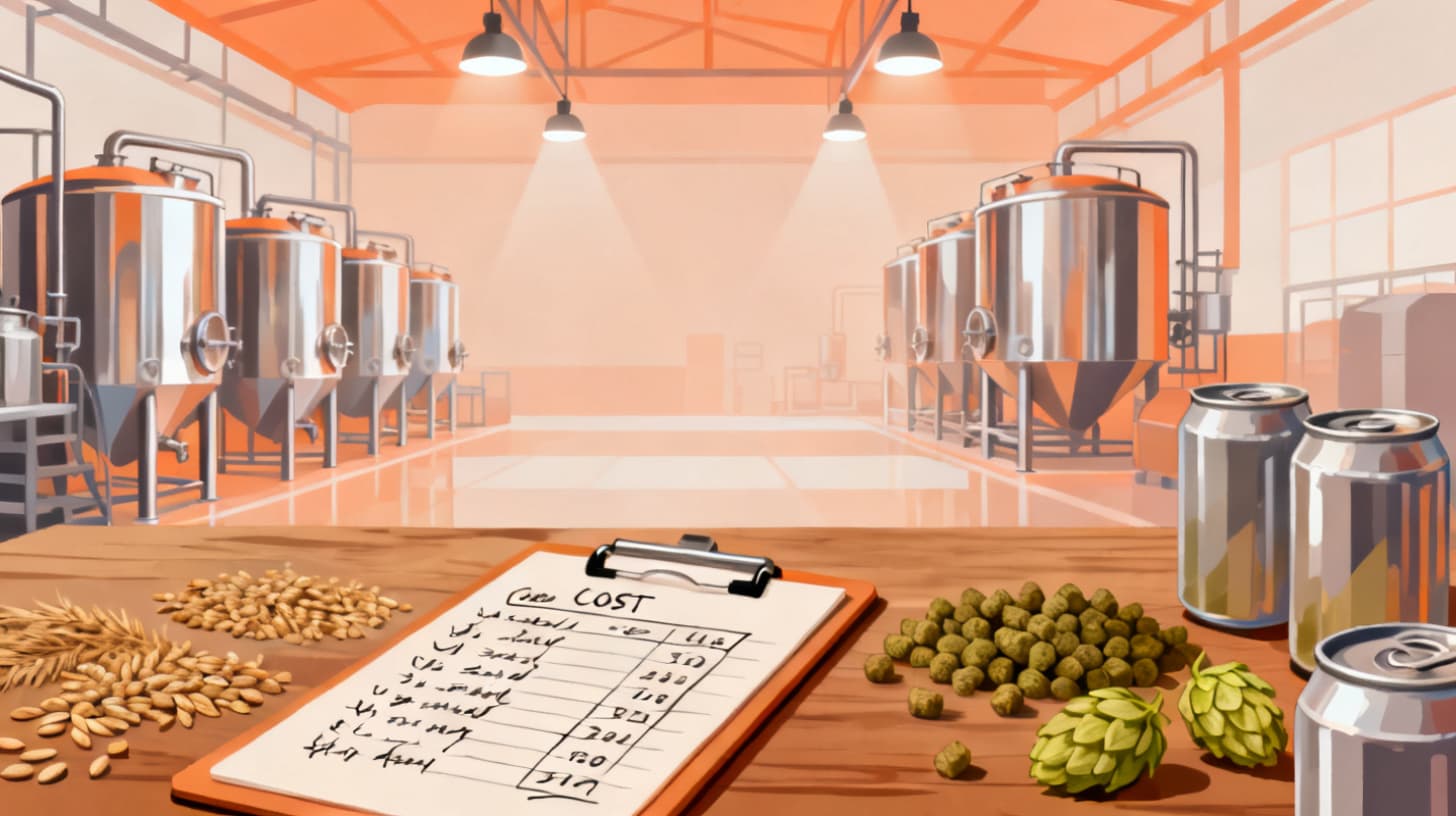
A barrel of beer costs more than most brewery owners think. Not because ingredients are expensive (though they can be), but because the real cost hides in places you're not tracking. Utilities during a long boil. The hour your cellar team spent dry-hopping. The keg that came back damaged. The cleaning chemicals between batches.
When you know your true cost per barrel, pricing decisions stop being guesswork. Taproom pours, distributor margins, and new recipe launches all snap into focus. When you don't know it, you end up selling your most popular beer at a loss and wondering why a packed taproom doesn't translate to a healthy bank account.
With craft beer volume facing downward pressure across the industry, according to the Brewers Association's national production data, the breweries that thrive are the ones that understand their numbers cold. This guide walks you through how to calculate a complete, honest cost per barrel, and more importantly, how to use that number to make smarter decisions about what you brew, how you price it, and where you invest next.
If you're still cobbling together spreadsheets and guessing at costs, BrewPlanner's inventory management tools can automate much of this work by tracking ingredient consumption, stock levels, and costs at the batch level. But even before you adopt software, the framework below will change how you think about profitability.
Building a Complete Cost Per Barrel From the Ground Up
Most brewers can rattle off their grain and hop costs per batch without blinking. That's the easy part. The hard part is capturing everything else that goes into producing a finished barrel of beer, packaging it, and getting it out the door. Let's build a true cost model piece by piece.
Direct Materials: Beyond the Recipe Card
Your bill of materials is the starting point: base malt, specialty grains, hops, yeast, water treatment chemicals, and any adjuncts. But a recipe card only tells you the theoretical usage. Real-world brewing involves overflows, trub loss, yeast harvesting inefficiencies, and the occasional dropped bag of grain. A good cost model uses actual consumption numbers rather than theoretical ones.
Start by tracking what you actually pull from inventory for each batch, not what the recipe says you should use. Over ten batches of the same beer, you might discover you're using 5-8% more grain than the recipe calls for. That variance adds up fast.
Don't forget consumables that don't appear on the recipe card: fining agents, dry hop bags, dissolved oxygen absorbers, and tank cleaning chemicals. These are direct costs tied to production, and skipping them means your cost per barrel is artificially low.
A practical example: Say your IPA recipe calls for 600 pounds of grain per 10-barrel batch. At $0.55 per pound, that's $330 in grain. But actual pulls average 640 pounds because of mill losses and mash tun dead space. Your real grain cost is $352, not $330. Across 100 batches per year, that's $2,200 in untracked grain cost for a single beer.
Direct Labor: The Hours That Touch the Beer
Labor is often the biggest line item in a brewery's cost structure, yet it's the one most commonly excluded from per-barrel calculations. Every hour your brewer spends mashing in, monitoring fermentation, transferring between tanks, and packaging beer is a direct production cost.
Calculate your fully loaded labor rate (hourly wage plus benefits, payroll taxes, and workers' comp) and multiply by the hours each batch requires at every stage: brewday, cellar work, and packaging. A 10-barrel batch that takes 8 hours on brew day, 3 hours of cellar work across fermentation, and 6 hours to package uses 17 labor hours. At a fully loaded rate of $25 per hour, that's $425 in labor, or $42.50 per barrel.
Track this separately for different beers. A clean lager that needs decoction mashing and extended lagering eats more labor hours than a simple pale ale. If you price them the same, the lager is quietly destroying your margins.
Overhead Allocation: Spreading the Fixed Costs
Here's where most cost-per-barrel calculations fall apart. Rent, insurance, equipment depreciation, loan payments, utilities, and administrative salaries don't change based on how much beer you brew, but they absolutely must be accounted for in your per-barrel cost.
The simplest approach: take your total monthly overhead and divide it by the number of barrels you produce that month. If your fixed overhead runs $30,000 per month and you produce 300 barrels, your overhead allocation is $100 per barrel. Brew 400 barrels with the same overhead and it drops to $75. This is exactly why capacity utilization matters so much for brewery profitability.
For a more refined picture, split overhead into production-related (utilities, equipment depreciation, maintenance) and administrative (office rent, accounting software, marketing). Allocate production overhead per barrel and administrative overhead as a percentage of revenue. This gives you a cleaner look at what it truly costs to make the beer versus run the business.
Packaging and Delivery: The Last Mile Costs
Cans, labels, carriers, cardboard trays, pallet wrap, kegs, keg collars, crowlers, and growler fills all carry costs. Packaging costs vary dramatically by format. A barrel of beer sold in 16oz four-packs costs significantly more to package than the same barrel sold in a keg.
Build separate cost-per-barrel figures for each packaging format:
FormatPackaging Cost Per BBLNotes1/2 BBL Keg$8-15Assumes owned kegs, amortized16oz 4-Packs$45-70Cans, labels, carriers, trays12oz 6-Packs$55-80Higher unit count per barrelCrowlers/Growlers$30-50Varies by container cost
Delivery costs (fuel, vehicle maintenance, driver wages, distributor margins) should be layered on top. A self-distributed barrel going to a local account costs far less than one shipped through a distributor at a 30% margin.
When you add all four categories together, direct materials plus direct labor plus overhead allocation plus packaging, you get your true, all-in cost per barrel. For most craft breweries producing under 5,000 barrels annually, this number typically lands between $150 and $350 per barrel depending on the beer style, packaging format, and local cost structure.
Using Your Cost Per Barrel to Set Prices That Actually Work
Knowing your cost per barrel is only valuable if you use it. The most immediate application is pricing, and it's where most breweries leave money on the table.
Margin Targets by Sales Channel
Different channels carry different costs and different margin expectations. Your taproom pours should carry the highest margin because you're the retailer. Distribution carries the lowest because you're sharing margin with a distributor and a retailer.
Set minimum gross margin targets for each channel:
- Taproom draft: 75-85% gross margin (you're the retailer, capture the full spread)
- Taproom packaged to-go: 60-70% gross margin
- Self-distribution to accounts: 45-55% gross margin
- Distributor wholesale: 30-40% gross margin
Now work backward. If your IPA costs $220 per barrel all-in (packaged in cans) and you want a 50% margin through self-distribution, your wholesale price needs to be at least $440 per barrel. Divide that by the number of cases per barrel (roughly 13.8 cases of 16oz four-packs) and you get a minimum case price of about $31.90.
If accounts won't pay that price, you don't have a sales problem. You have a cost problem or a product-channel fit problem. This is the kind of clarity that a real cost per barrel gives you.
Identifying Your Most and Least Profitable Beers
Run the full cost calculation for every beer in your lineup. You'll almost certainly discover surprises. The barrel-aged stout that sells for a premium might actually have lower margins than your session ale once you account for the extended tank time, barrel cost amortization, and higher ingredient bill. The hazy IPA that flies off shelves might be your least profitable beer per barrel because of expensive hop contracts and heavy dry-hop losses.
Once you have real margin data by SKU, you can make rational decisions about your lineup. For a deeper dive into evaluating which beers deserve production capacity and which ones don't, check out this guide on running a SKU rationalization audit using margin data.
The Tank Time Factor
One cost that rarely shows up in per-barrel calculations is the opportunity cost of tank time. Every day a fermenter holds a lager that could be occupied by an IPA that ferments in half the time, you're losing potential revenue.
Think of each fermenter as a revenue-generating asset. A 20-barrel fermenter that turns over every 14 days produces roughly 520 barrels per year. The same tank holding a lager for 42 days produces only about 174 barrels. If both beers carry $100 per barrel in gross profit, the IPA generates $52,000 per year from that tank versus $17,400 for the lager. That $34,600 difference is the opportunity cost of brewing the lager.
This doesn't mean you should stop brewing lagers. It means you should price them to reflect their true cost, including the tank time they consume.
Turning Cost Data Into Operational Decisions
Pricing is the most obvious use of cost-per-barrel data, but the real power lies in operational decision-making. When you can see exactly where your money goes, you can pull specific levers to improve profitability without raising prices or cutting quality.
Ingredient Sourcing and Purchasing Decisions
With accurate per-barrel costs broken down by ingredient, you can evaluate purchasing decisions with precision. Should you buy malt in bulk at a discount? Calculate the carrying cost of storing extra inventory (warehouse space, capital tied up, potential spoilage) and compare it to the per-pound savings. For many breweries, buying a full truckload of base malt saves 10-15% on grain cost per barrel, which on a 2,000-barrel annual production can translate to $3,000-$5,000 in savings.
The same analysis works for hop contracts. Locking in a multi-year contract on your core hop varieties protects you from price spikes, but it also commits capital. Your cost-per-barrel model tells you exactly what percentage of total cost each hop variety represents, so you can prioritize contracts for the varieties that move the needle most.
BrewPlanner's inventory management system tracks costs at the ingredient level and ties them to specific batches through bill-of-materials configurations. This means you can see not just what you paid for Citra hops, but exactly how much Citra cost went into each barrel of each beer that uses it. That level of visibility makes purchasing negotiations far more strategic.
Capacity Planning and Expansion Timing
Your overhead cost per barrel drops as production volume increases, but only up to the point where you need to add capacity. Understanding this relationship helps you time equipment purchases and expansion decisions.
Map out your overhead cost per barrel at different production volumes:
Annual ProductionMonthly OverheadOverhead Per BBL500 BBL$25,000$600.001,000 BBL$25,000$300.001,500 BBL$28,000$224.002,000 BBL$32,000$192.002,500 BBL$45,000$216.00
Notice that jump at 2,500 barrels? That's where you've hit the ceiling of your current equipment and need to add a fermenter, hire another cellar worker, or expand cold storage. Your overhead per barrel actually increases before the new capacity is fully utilized. Knowing this helps you plan the timing of expansion so you're growing into added capacity rather than drowning in it.
Batch Size Optimization
If your brewhouse can produce 15-barrel batches but you're regularly brewing 10-barrel batches because that's what demand supports for a specific beer, your per-barrel cost for that beer is inflated. The brewhouse labor, utilities, and cleaning are roughly the same whether you brew 10 or 15 barrels.
You have a few options: brew full batches less frequently, blend similar recipes to fill the brewhouse, or phase out low-volume beers that can't justify a full brew day. Your cost model tells you exactly how much each under-filled batch costs you, making the decision concrete rather than abstract.
Tracking Costs Over Time
A single cost-per-barrel snapshot is useful. A trend line is transformative. Track your all-in cost per barrel monthly and watch for drift. Rising costs might indicate supplier price increases you haven't adjusted for, creeping inefficiencies in your process, or equipment that needs maintenance (a failing heat exchanger uses more water and takes longer to cool wort).
Set up a simple dashboard that shows cost per barrel by beer, by month, broken into the four categories (materials, labor, overhead, packaging). When a number moves, you'll know exactly where to look.
Building a System That Tracks Costs Automatically
The framework above works even with spreadsheets, but manual tracking has a shelf life. As your brewery grows, the number of batches, ingredients, packaging formats, and sales channels multiplies the complexity until spreadsheets become unreliable.
The breweries that maintain accurate cost visibility as they scale are the ones that build systems early. This means connecting your recipe formulation to your inventory to your production schedule to your accounting. When those systems talk to each other, cost per barrel calculations happen automatically with every batch.
Here's what that looks like in practice:
- 1Recipe with a bill of materials that lists every ingredient and its current cost
- 2Inventory system that records actual pulls per batch, not just theoretical usage
- 3Production schedule that captures labor hours by batch and stage
- 4Overhead allocation formula that distributes fixed costs based on actual production volume
- 5Packaging cost module that applies format-specific costs per barrel
When these five elements are connected, finishing a batch automatically generates a complete cost breakdown. No manual data entry, no formula errors, no month-end scrambles to figure out what happened.
BrewPlanner's brewery management platform was built to connect exactly these pieces. From bill-of-materials configurations and real-time inventory tracking to production scheduling and batch-level cost reports, it replaces the disconnected spreadsheets and gives you a single source of truth for what your beer actually costs.
The goal isn't to become an accountant. It's to have the numbers you need, when you need them, so you can focus on making great beer and running a profitable business. Every pricing conversation, every expansion decision, every new beer launch gets sharper when you know your true cost per barrel.
Ready to see how automated batch costing works in practice? Schedule a demo with the BrewPlanner team and walk through your specific production setup with someone who understands brewery operations.