You've got a hefeweizen that needs three days in the brewhouse, a stout sitting in a fermenter for two weeks, and a lager that's been conditioning in a brite tank since last Tuesday. Now someone just placed a rush order for your flagship IPA, and you're staring at a whiteboard full of scribbled tank assignments wondering where it's going to fit.
Sound familiar? If you're running a growing brewery, scheduling production across multiple tanks is one of the most operationally complex challenges you'll face. Get it wrong, and you're looking at double-booked tanks, idle equipment, delayed shipments, and wasted ingredients. Get it right, and your production floor hums like a well-tuned engine.
The problem isn't that brewers lack knowledge. It's that most breweries outgrow their scheduling systems long before they realize it. Spreadsheets and whiteboards work when you have two fermenters. They fall apart when you have eight tanks across three phases of production and a taproom demanding fresh kegs every week.
This guide breaks down a practical framework for planning and scheduling brewing orders across your brewhouse, fermenters, and brite tanks without ever double-booking a vessel. Whether you're managing five tanks or fifty, these principles will help you build a scheduling workflow that scales with your operation. And if you're ready to move beyond manual tracking, BrewPlanner offers a visual dashboard scheduling grid designed specifically for multi-tank brewery production planning.
Understanding the Three-Phase Tank Pipeline
Before you can schedule effectively, you need to think about your brewery as a pipeline with three distinct phases, each with its own tank type, time requirements, and constraints. Every brewing order flows through this pipeline, and the key to avoiding double-bookings is understanding how orders move between phases and where bottlenecks form.
The first phase is the brewhouse. This is where raw ingredients become wort. Brewhouse time is typically measured in hours, not days. A single brew day might occupy your brewhouse for 8 to 12 hours, depending on your system, batch size, and cleaning protocols. Because brewhouse time is relatively short, it rarely causes scheduling conflicts on its own. The challenge comes from what happens next.
The second phase is fermentation. Once wort leaves the brewhouse, it moves to a fermenter (FV) where yeast does its work. This is where scheduling gets tricky. Fermentation times vary wildly depending on the beer style. An American pale ale might need 7 to 10 days. A Belgian tripel could sit for three weeks. A lager undergoing cold conditioning might occupy a fermenter for a month or more. When you have four fermenters and six orders with different fermentation timelines, you can see how conflicts multiply fast.
The third phase is the brite tank (BT). After fermentation, beer transfers to a brite tank for carbonation, clarification, and packaging preparation. Brite tank time is typically shorter than fermentation, often 3 to 7 days, but it creates its own scheduling pressure because it's the final bottleneck before packaging. If a brite tank isn't available when a fermenter finishes, that beer sits in the fermenter longer than planned, which delays the next batch waiting for that fermenter.
This cascading dependency is exactly why tank scheduling is so difficult. A delay in one phase ripples forward and backward through your entire production calendar. According to the Brewers Association, the number of craft breweries continues to grow, and as breweries scale production, managing this pipeline efficiently becomes the difference between profitable operations and constant firefighting.
The practical takeaway here is simple: map out the expected duration of each phase for every beer style you brew. If your hefeweizen takes 1 day in the brewhouse, 10 days in fermentation, and 5 days in the brite tank, that's a 16-day total pipeline. Your imperial stout might need 1 day, 21 days, and 7 days for a 29-day pipeline. These timelines are the foundation of every scheduling decision you'll make.
Create a reference sheet or configure your beer styles with default durations for each phase. When a new order comes in, you can immediately estimate when each tank will be needed and for how long. This is far more effective than scheduling reactively, where you only think about tank availability when it's time to brew.
Building a Visual Scheduling Grid That Actually Works
Once you understand your tank pipeline, the next step is building a scheduling system that gives you a clear visual picture of what's happening across all your tanks at any point in time. This is where most breweries stumble, because the tools they use weren't designed for this kind of multi-resource, multi-phase scheduling.
Why Spreadsheets Break Down
Spreadsheets are the default tool for small breweries, and they work fine for a while. You create a tab for each month, list your tanks as rows, and color-code cells to show which beer is in which tank on which day. The problems emerge gradually.
First, spreadsheets don't enforce constraints. Nothing stops you from accidentally assigning two beers to the same fermenter on the same day. You'll only discover the conflict when it's time to transfer and there's no available tank. Second, spreadsheets don't handle cascading changes well. If fermentation on your IPA runs two days longer than expected, you need to manually shift every downstream assignment, check for new conflicts, and update multiple cells. Third, spreadsheets don't give you a real-time view. If your head brewer updates the schedule on their laptop, your packaging lead won't see the change until someone sends a new version.
What a Scheduling Grid Needs
An effective brewery scheduling grid needs four things:
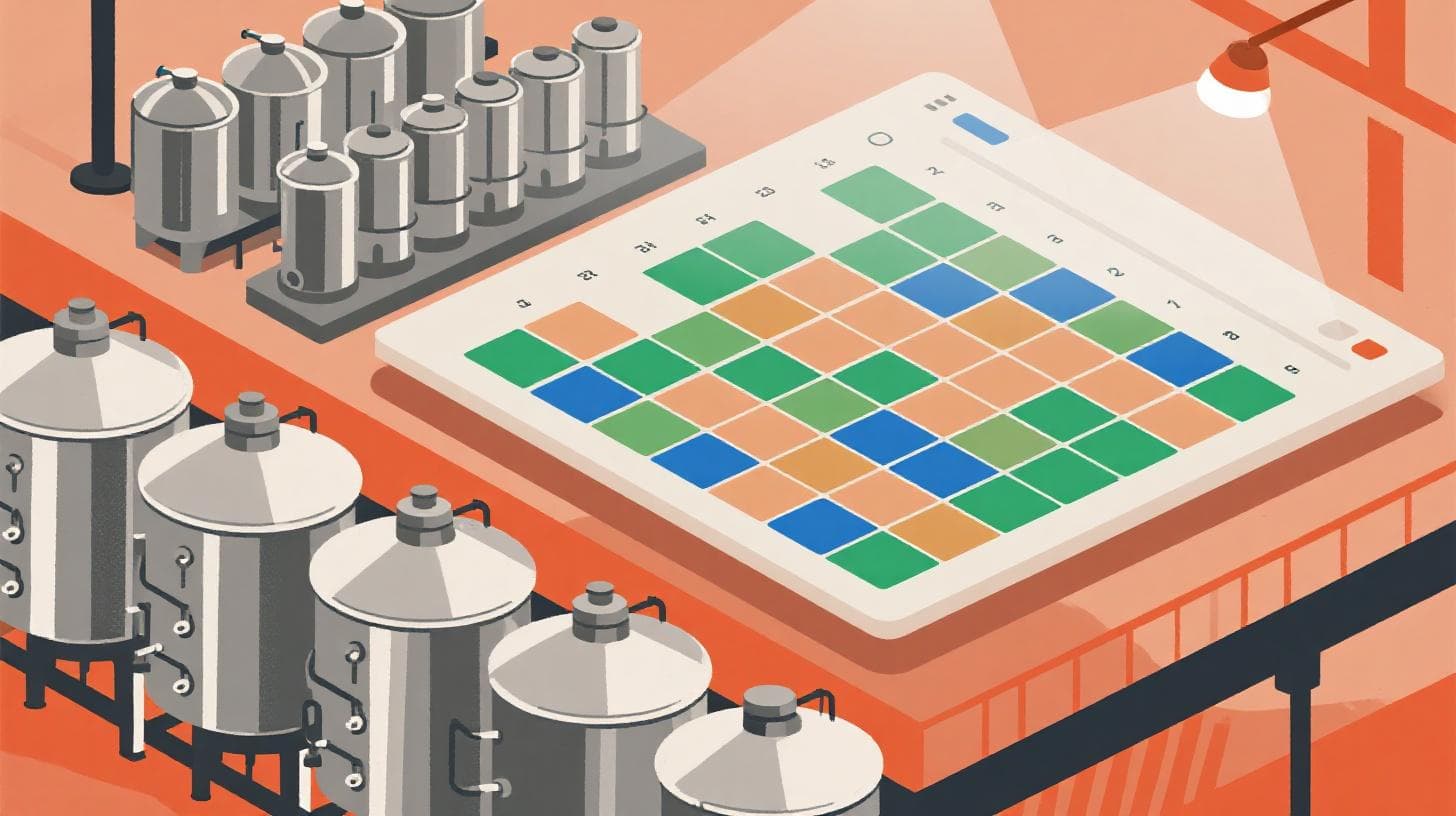
- 1A timeline view showing all tanks simultaneously. You should be able to see your entire tank inventory, grouped by type (brewhouse, fermenter, brite tank), with orders displayed as blocks spanning their expected duration. This gives you an instant view of capacity and conflicts.
- 2Drag-and-drop assignment. When a new order comes in, you should be able to visually place it on an available tank by dragging the order block to the appropriate row and date range. If you need to reschedule, you drag it to a new position and immediately see whether it conflicts with anything.
- 3Conflict detection. The system should prevent or flag double-bookings automatically. If you try to assign a batch to a fermenter that's already occupied, you need to know before you commit to that schedule.
- 4Phase-aware scheduling. Each order needs assignments across all three tank types, and the system should understand that the fermenter assignment must start after the brewhouse phase ends, and the brite tank assignment must start after fermentation completes. This phase sequencing is the backbone of a conflict-free schedule.
If you want to see what this looks like in practice, BrewPlanner provides exactly this kind of visual scheduling grid. Orders appear as color-coded blocks across your tank timeline, and you can drag them between tanks to find the optimal arrangement. The system tracks brewhouse, fermenter, and brite tank phases for each order and flags scheduling conflicts before they become production problems.
Planning Capacity Before Committing Orders
One of the most powerful scheduling habits you can adopt is working with draft schedules before publishing them to your production team. Here's how this works in practice:
When new orders come in, don't immediately assign them to tanks. Instead, create a draft schedule where you can experiment with different arrangements. Maybe your IPA fits in Fermenter 3 starting Monday, but that means your porter can't start until the following week. What if you moved the porter to Fermenter 1 instead? A draft system lets you play out these scenarios without disrupting your live production calendar.
Once you've found an arrangement that works, with no double-bookings, efficient tank utilization, and realistic timelines, you publish the schedule. Your team sees the final version, not the fifteen iterations you went through to get there. For deeper guidance on structuring your tank scheduling workflow, check out How to Set Up Brewery Tank Scheduling That Prevents Bottlenecks.
Preventing Double-Bookings With Practical Scheduling Strategies
Having the right tools matters, but tools alone won't prevent scheduling disasters. You need consistent strategies and habits that keep your tank calendar accurate and conflict-free. Here are the most effective approaches, drawn from how successful multi-tank breweries manage their production.
Strategy 1: Schedule Backward From Delivery Dates
Most brewers schedule forward. They pick a brew day, estimate fermentation time, and hope the beer is ready when they need it. This approach leads to two common problems: you end up with beer ready too early (occupying a brite tank longer than necessary) or too late (missing delivery commitments).
Backward scheduling flips this approach. Start with the date you need packaged beer, then work backward:
- Packaging date: March 20
- Brite tank needed: March 15 through March 20 (5 days)
- Fermentation needed: March 1 through March 14 (14 days)
- Brew day: February 28 (1 day in brewhouse)
Now check each tank type for availability on those dates. If Fermenter 2 is occupied March 1 through 14, look at Fermenter 3. If no fermenters are available, you either need to adjust the delivery date or find a way to free up capacity. Backward scheduling makes these conflicts visible early, when you still have time to adjust.
Strategy 2: Build Buffer Days Into Every Phase
Fermentation is biology, not engineering. Yeast doesn't read your production schedule. If you plan for exactly 10 days of fermentation and it takes 12, your entire downstream schedule breaks.
The fix is straightforward: add buffer days to every phase. A good starting point is 1 to 2 buffer days for fermentation and 1 buffer day for brite tank conditioning. So if your recipe typically ferments in 10 days, schedule the fermenter for 12 days. This gives you breathing room without significantly reducing your annual capacity.
Yes, buffer days reduce the theoretical number of batches you can produce per year. But the alternative, a schedule so tight that one slow fermentation causes a chain reaction of delays, costs more in the long run through rush orders, overtime labor, and missed deliveries.
Strategy 3: Standardize Your Beer Style Timelines
Every beer style in your portfolio should have a documented default timeline for each production phase. This isn't a rigid rule that can never change, but a baseline that makes scheduling predictable and repeatable.
For example:
Beer StyleBrewhouseFermentationBrite TankTotal PipelineAmerican IPA1 day12 days5 days18 daysHefeweizen1 day10 days4 days15 daysImperial Stout1 day21 days7 days29 daysPilsner1 day28 days5 days34 daysSession Ale1 day7 days3 days11 days
When you configure these defaults into your scheduling system, every new order automatically populates with the right time blocks. You can always override them for specific batches, but having defaults means you're not guessing every time.
Strategy 4: Track Tank Volume Alongside Time
Double-booking isn't just about time. It's also about volume. If you have a 30-barrel fermenter and a 15-barrel order, you might be tempted to think you can fit two 15-barrel batches in the same tank. Some breweries do blend batches this way, but it requires careful planning and isn't always appropriate.
Your scheduling system should track each tank's volume capacity alongside its time availability. When assigning an order to a tank, verify that the batch size fits the vessel. A 20-barrel batch in a 15-barrel fermenter is just as much of a conflict as two batches in the same tank at the same time.
Strategy 5: Review Your Schedule Weekly
Even the best scheduling system degrades without regular maintenance. Set a weekly scheduling review where you:
- Confirm all active fermentations are on track with expected timelines
- Verify upcoming brew days have available fermenters for transfer
- Check that brite tanks will be free when current fermentations complete
- Update any batches that are running ahead of or behind schedule
- Review incoming orders and tentatively assign them to the draft schedule
This 30-minute weekly habit catches problems days before they become emergencies. It's the single most effective practice for maintaining a conflict-free production calendar.
Scaling Your Scheduling Process as You Grow
The strategies above will serve you well whether you have 3 tanks or 30. But as your brewery grows, the complexity of scheduling increases exponentially. Every new tank adds capacity, but it also adds another variable to manage. Every new beer style introduces a different pipeline duration. Every new sales channel creates delivery commitments that constrain your scheduling flexibility.
Growth forces a transition point. Below a certain size, a disciplined brewer with good habits can keep the schedule in their head, supported by a spreadsheet or a whiteboard. Above that threshold, the number of variables exceeds what any one person can reliably track. This is typically when breweries have 6 or more tanks, brew 3 or more times per week, and carry 8 or more active beer styles.
At this point, you need a system that does three things your brain and your spreadsheet cannot.
First, it needs to maintain a single source of truth that everyone on your team can access simultaneously. When the head brewer adjusts a fermentation timeline, the packaging team should see that change immediately. When sales commits to a delivery date, production should know about the new constraint without a phone call or a sticky note.
Second, it needs to automate conflict detection so you're not relying on visual scanning to catch overlapping assignments. With 10 fermenters and 20 active orders, manually checking every tank for every date range isn't practical. The system should flag conflicts the moment they occur, whether from a new assignment or a timeline change.
Third, it needs to support lifecycle management for your orders. A brewing order isn't just a tank assignment. It moves from draft to published to archived. It has a batch number, associated recipes, material requirements, and notes from the brewing team. Connecting all of this to your tank schedule means you're not just avoiding double-bookings, you're managing your entire production workflow from a single platform.
This is exactly the problem that purpose-built brewery management software solves. Rather than stitching together spreadsheets, calendars, and messaging apps, you get a unified system where orders, tanks, schedules, and team communication live in one place.
If your brewery is at or approaching this transition point, take a look at what BrewPlanner offers. The platform was built around the visual scheduling grid concept described in this article, with drag-and-drop tank assignment across brewhouse, fermenter, and brite tank phases, automatic batch number generation, brewing and packaging notes, and a draft schedule system that lets you plan changes before publishing them to your team. You can explore plans and pricing at BrewPlanner Pricing to find the right fit for your operation.
The bottom line is this: double-booking tanks isn't a character flaw or a sign of incompetence. It's the inevitable result of managing complex, multi-phase production with tools that weren't designed for the job. Map your pipeline, build a visual scheduling grid, adopt the five strategies outlined above, and invest in systems that scale with your growth. Your production floor, your team, and your customers will thank you.