Running out of a single hop variety mid-brew is enough to ruin an entire batch, your production schedule, and possibly your week. On the flip side, overstocking specialty malt that you only use in one seasonal release ties up cash and warehouse space you can't afford to waste. The sweet spot between "not enough" and "way too much" is where reorder points and par levels live, and getting them right is one of the most impactful things a brewery can do for its bottom line.
Whether you're brewing five barrels or fifty, a disciplined approach to inventory thresholds keeps your raw materials flowing without turning your warehouse into a graveyard of expiring ingredients. This guide walks you through the exact formulas, real-world examples, and practical steps to set up reorder points and par levels for every raw material in your brewery.
Understanding Reorder Points and Par Levels for Breweries
Before diving into spreadsheets and formulas, let's get clear on what these two terms actually mean in a brewery context, because they're related but not the same thing.
A reorder point is the specific inventory quantity at which you need to place a new order with your supplier. When your stock of a given ingredient drops to this number, it's time to pick up the phone or fire off a purchase order. The reorder point accounts for how much of that ingredient you'll consume while waiting for the new shipment to arrive.
A par level is the ideal maximum quantity you want to have on hand at any given time. Think of it as your inventory ceiling. It factors in your storage capacity, ingredient shelf life, and how much capital you're comfortable tying up in raw materials.
Together, these two numbers create a healthy operating range for every ingredient. Your stock oscillates between the par level (right after a delivery arrives) and the reorder point (the moment you trigger a new order). When both are dialed in correctly, you never run out and you never overstock.
Why Breweries Get This Wrong
Most small and mid-size breweries manage reorder decisions by gut feeling. The head brewer glances at the grain room, notices the pale malt is getting low, and texts the owner to order more. This works until it doesn't, and it usually stops working right when you start scaling.
Common mistakes include treating all ingredients the same (hops, malt, yeast, and water chemistry additions all have wildly different lead times and shelf lives), ignoring supplier variability, and failing to adjust for seasonal production swings. A brewery that brews twice as many IPAs in summer but keeps the same hop reorder point year-round will either run short during peak season or sit on excess during slower months.
The fix is straightforward: calculate reorder points and par levels using actual data, not memory. You need three pieces of information for each raw material: your average daily or weekly usage rate, your supplier's lead time, and a safety stock buffer for variability.
The Core Formulas
Here's the math, broken down simply:
Reorder Point = (Average Daily Usage × Lead Time in Days) + Safety Stock
Par Level = Reorder Point + Economic Order Quantity (EOQ)
The safety stock piece is what protects you from surprises, whether that's a late delivery, a spike in demand, or a bad batch that forces you to re-brew. A common approach is to calculate safety stock as:
Safety Stock = (Maximum Daily Usage − Average Daily Usage) × Lead Time
Let's make this concrete. Say your brewery uses 200 pounds of 2-row pale malt per week on average (roughly 29 lbs/day). Your supplier typically delivers in 5 business days. During your busiest weeks, usage jumps to 300 lbs/week (43 lbs/day).
- Safety Stock = (43 − 29) × 5 = 70 lbs
- Reorder Point = (29 × 5) + 70 = 215 lbs
- If your economic order quantity is 500 lbs (one pallet), then Par Level = 215 + 500 = 715 lbs
This means you order a pallet of 2-row whenever your stock hits 215 pounds, and right after delivery, you're sitting at roughly 715 pounds. Simple, repeatable, and far more reliable than eyeballing the grain room.
Setting Up Reorder Points for Every Ingredient Category
Not all raw materials behave the same way. Hops degrade faster than grain. Yeast has a limited viability window. Water chemistry additions are shelf-stable but often come from specialty suppliers with longer lead times. You need to tailor your approach for each category.
Grain and Malt
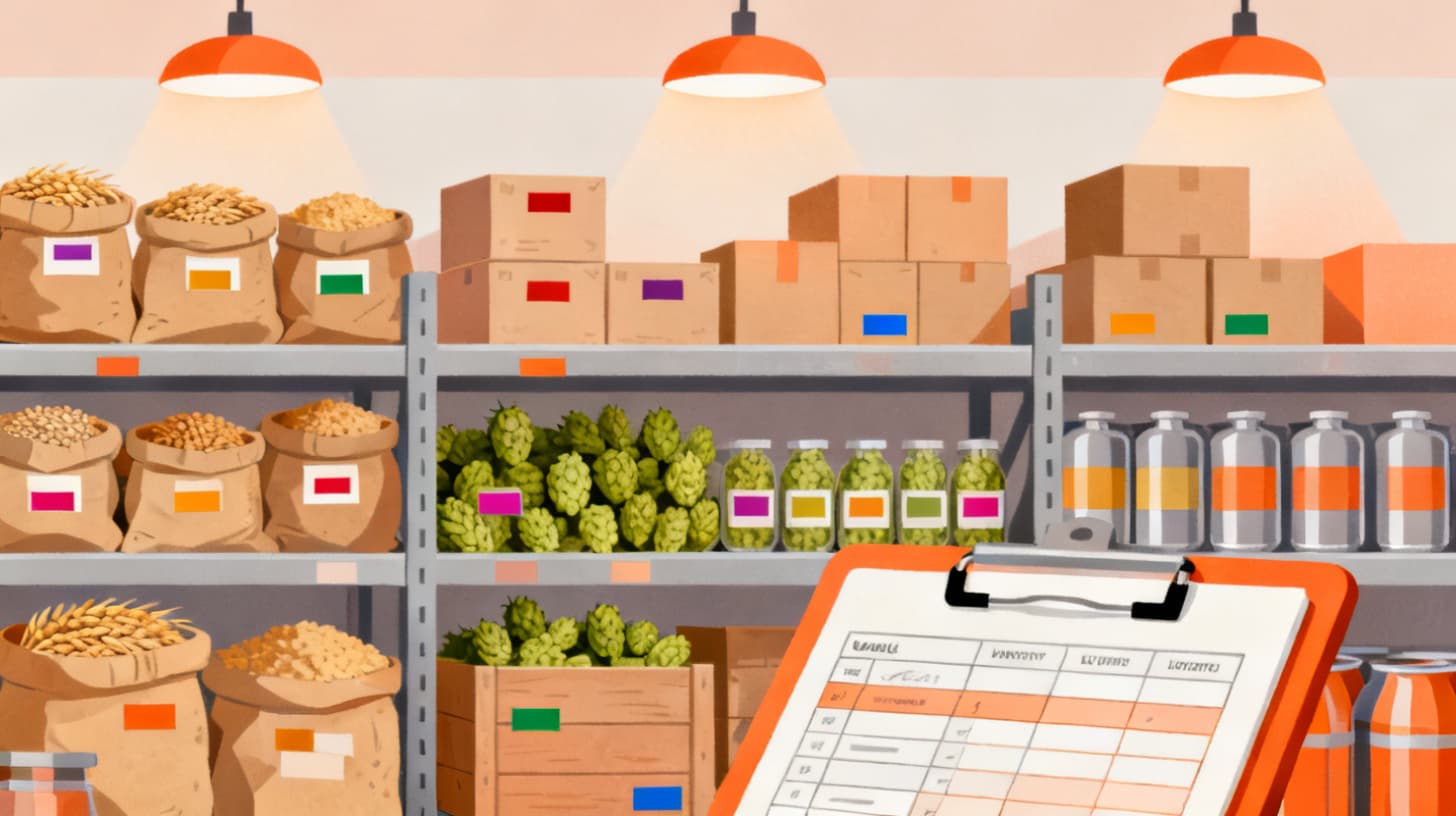
Base malts like 2-row and Pilsner malt are your highest-volume ingredients. They're relatively shelf-stable (6 to 12 months when stored properly), widely available, and often ordered in bulk. Because they're high-volume and low-risk, your safety stock multiplier can be modest.
Specialty malts are trickier. You might only use 25 pounds of chocolate malt per month, but if your supplier is out of stock, there's no easy substitute that won't change your beer. For low-usage specialty grains, consider bumping your safety stock multiplier by 50% to account for supply inconsistency.
Malt TypeAvg. Weekly UsageLead TimeSafety StockReorder Point2-Row Pale200 lbs5 days70 lbs215 lbsMunich50 lbs7 days30 lbs80 lbsChocolate10 lbs10 days15 lbs29 lbsWheat75 lbs5 days25 lbs79 lbs
Tracking your actual grain usage per batch is the foundation of accuracy. When your bill of materials for each product specifies exactly how much grain goes into every recipe, pulling your average weekly usage becomes a simple calculation rather than guesswork.
Hops
Hops introduce a wrinkle that grain doesn't: they're harvested once a year, and many varieties sell out quickly. If you rely on a specific hop for your flagship IPA, your reorder strategy might involve contracting for an annual supply rather than ordering on a rolling basis.
For hops you buy on the spot market or from distributors with ongoing stock, apply the standard formula but use a higher safety stock multiplier. Hop suppliers can be unpredictable, and substitution changes your beer's character.
Also factor in storage degradation. Hops stored in your walk-in cooler lose alpha acids over time. Ordering a full year's supply might save money on per-pound cost but could leave you with diminished hops by the end of the year if your cold storage isn't ideal.
Yeast
Yeast is perishable and time-sensitive. Most liquid yeast pitches have a viability window of weeks, not months. Your reorder point calculation needs to account for this shelf life constraint.
For breweries that repitch yeast from batch to batch, your "reorder point" is really a backup trigger. If you lose a generation due to contamination or off-flavors, you need fresh yeast fast. Keep enough backup pitches on hand (or a standing arrangement with your yeast lab) to cover at least one emergency re-pitch per active strain.
Water Chemistry and Fining Agents
Calcium chloride, gypsum, phosphoric acid, and fining agents like gelatin or Biofine are low-volume, high-impact ingredients. Running out of gypsum won't stop a brew day, but it will change the beer. These items often come from specialty chemical suppliers with lead times of one to two weeks.
Because the dollar value is low and shelf life is long, it's smart to set par levels generously for water chemistry additions. Holding an extra 10 pounds of gypsum costs you almost nothing but protects you from production disruption.
Implementing and Maintaining Your Inventory Thresholds
Knowing the formulas is only half the battle. The real challenge is building a system that alerts you when stock hits a reorder point and keeps your par levels current as your production evolves.
Step 1: Audit Your Current Inventory and Usage Data
Before setting any thresholds, you need a clear picture of what you have and how fast you're using it. Pull your production records from the last three to six months. For every raw material, calculate:
- Total quantity consumed
- Number of batches brewed
- Average usage per batch
- Average weekly usage
- Peak weekly usage (your busiest week)
If your records are spotty, start by tracking usage going forward. Log every ingredient pull at the batch level. Within a few production cycles, you'll have enough data to set meaningful reorder points. Understanding your true cost per batch depends on this same usage data, so the effort pays off in multiple ways.
Step 2: Document Lead Times for Every Supplier
Call your suppliers. Ask them point-blank: "What's your typical turnaround from order to delivery?" Then add a buffer, because suppliers are optimistic. If they say 5 days, plan for 7. If they say next week, plan for 10 days.
Build a supplier lead time table and review it quarterly. Lead times shift with seasons, supply chain disruptions, and your order size. A supplier who ships 50-pound sacks in 3 days might take 2 weeks for a full pallet.
SupplierMaterialQuoted Lead TimeActual Avg. Lead TimeBuffer Lead TimeMaltcoBase Malts3-5 days5 days7 daysHopDirectPellet Hops5-7 days8 days10 daysYeastLabLiquid Yeast2-3 days3 days5 daysChemSupplyWater Salts7-10 days12 days14 days
Step 3: Calculate and Enter Thresholds
With your usage data and lead times in hand, run the formulas for every raw material. Don't skip the low-volume items. It's tempting to only set reorder points for your big ingredients, but it's the obscure specialty malt or the specific yeast nutrient that actually causes brew day cancellations when it runs out.
Using inventory management software that supports stock levels, transaction tracking, and multi-location warehousing makes this dramatically easier. Instead of checking a spreadsheet manually, you can track stock in real time as ingredients move in and out. When you record a transaction for pulling 200 pounds of grain from your warehouse, your stock level updates automatically, and you can immediately see whether you've crossed a reorder threshold.
Step 4: Connect Thresholds to Purchase Orders
A reorder point that nobody checks is useless. The ideal workflow looks like this:
- 1Stock drops to or below the reorder point
- 2The person responsible gets notified (or spots it during a regular inventory review)
- 3A purchase order is created for the supplier, specifying the quantity that brings stock back up to the par level
- 4The order is tracked through its lifecycle: pending, ordered, received
- 5Upon receiving, stock levels are updated
When your purchase order workflow ties directly to your stock tracking, you close the loop. There's no gap between "we need more" and "we ordered more" where things fall through the cracks.
Reviewing and Adjusting Your Levels Over Time
Setting reorder points and par levels isn't a one-time project. Your brewery changes. Your recipes evolve. Suppliers come and go. Seasonal demand shifts your usage patterns. If you set your thresholds once and forget them, they'll drift out of alignment within a few months.
Quarterly Reviews
Block out time every quarter to review your inventory thresholds. During each review, ask:
- Has our production volume changed? If you've added a new core beer or retired an old one, your usage rates for certain ingredients have shifted. Recalculate accordingly.
- Have lead times changed? Suppliers change shipping methods, run into their own supply issues, or adjust minimum order quantities. Update your lead time table.
- Did we experience any stockouts or overstocks? A stockout means your reorder point was too low or your safety stock was insufficient. An overstock (especially of perishable ingredients) means your par level was too high. Adjust by 10 to 20 percent in the appropriate direction.
- Are there new suppliers worth considering? A new local maltster with 2-day delivery might let you lower your reorder point for base malt and free up warehouse space.
Seasonal Adjustments
Many breweries have clear seasonal production patterns. If you brew heavily in spring and summer to stock the taproom during warm weather, your usage rates during those months are meaningfully higher than your annual average. Consider maintaining two sets of thresholds: a peak-season set and an off-season set.
For example, if your Citra hop usage doubles during your summer IPA push, your reorder point should reflect that doubled rate during those months. Sticking with the annual average will leave you short.
Tying It All Together
The best inventory management isn't about perfection. It's about building a repeatable system that catches problems before they become emergencies. A brewery with accurate reorder points might still occasionally run low on an ingredient, but it won't be blindsided. The system flags the issue early, giving you time to find alternatives or expedite an order.
Here's a quick checklist to confirm your setup is working:
- Every raw material has a documented reorder point and par level
- Supplier lead times are recorded and reviewed quarterly
- Stock levels are updated after every batch pull and every delivery
- Purchase orders are generated when reorder points are hit
- Thresholds are adjusted for seasonal production changes
- Perishable items have shelf life factored into par levels
Getting your reorder points and par levels right won't make you a better brewer, but it will make you a far better-run brewery. The difference between a chaotic operation and a smooth one often comes down to whether someone did the math on when to order more grain.
Ready to stop guessing and start tracking? BrewPlanner gives you the inventory tools, purchase order workflows, and stock tracking you need to manage every raw material with confidence. Set up your reorder points, connect them to your suppliers, and focus on what matters most: making great beer.