Every barrel of beer that disappears between the malt silo and the packaging line is money you never see again. For most craft breweries, total process losses range from 8% to 15% of starting volume, and that range can mean the difference between a profitable quarter and a painful one. The frustrating part? Many brewery owners know they're losing product somewhere, but they can't pinpoint exactly where or how much.
The problem isn't a lack of effort. It's a lack of visibility. When you're tracking volumes on whiteboards, scribbled logs, and disconnected spreadsheets, small losses compound into big ones without anyone noticing. A half-barrel lost to trub here, an extra gallon of yeast slurry there, a packaging run that comes up mysteriously short. None of these feel catastrophic in isolation, but across dozens of batches, they erode your margins steadily.
This is where purpose-built inventory software changes the game. By digitizing your grain-to-glass tracking, you create an unbroken chain of data that reveals exactly where product goes, how much you're losing at each stage, and what you can do about it. BrewPlanner was designed specifically for this kind of end-to-end brewery management, connecting raw material inventory, production phases, tank assignments, and packaging into a single system. The result is a clear picture of your true cost per barrel and, more importantly, the actionable insights to bring that cost down.
Let's walk through how brewing losses actually accumulate, why traditional tracking methods fail, and how to build a loss-reduction system that pays for itself.
Where Brewing Losses Actually Happen and Why They're Hard to Catch
Brewing losses don't happen in one dramatic event. They accumulate across multiple process stages, each with its own set of variables. Understanding the anatomy of loss is the first step toward controlling it.
Brewhouse Losses
The brewhouse is where your first significant volume reduction occurs, and it's also where many breweries stop paying close attention. Mash tun dead space, lauter tun grain absorption, and kettle boil-off are all expected losses, but the actual numbers vary widely depending on your equipment, recipes, and operating procedures.
Grain absorption alone typically accounts for 0.5 to 1 gallon per pound of grain. For a 10-barrel batch using 400 pounds of malt, that's 200 to 400 gallons absorbed and left behind. Kettle boil-off rates vary from 4% to 10% per hour depending on your heating system and kettle geometry. These are "normal" losses, but if you're not measuring them consistently, you won't notice when they drift upward. A worn seal on your lauter tun, a change in grain crush consistency, or a slightly longer boil can all push losses higher without an obvious red flag.
The challenge with brewhouse losses is that brewers often accept them as fixed costs. They're not. A brewery that tracks brewhouse efficiency batch over batch can identify drift patterns, correlate them with specific recipe or equipment variables, and make targeted adjustments. Without batch-level tracking tied to your inventory system, you're guessing.
Fermentation and Transfer Losses
Once wort moves into fermentation vessels, a different set of losses kicks in. Trub carryover from the kettle settles to the bottom of the fermenter, and yeast sediment builds up during fermentation. Together, these can represent 2% to 5% of fermenter volume, depending on the beer style, yeast strain, and how aggressively you crop.
Transfer losses between vessels add another layer. Every time beer moves from one tank to another (fermenter to brite tank, for example), you leave some behind in hoses, fittings, and tank dead legs. This is where sloppy process really costs you. A brewery running multiple transfers with poorly maintained connections can lose a surprising amount of product to drips, spills, and retained beer.
The Alcohol and Tobacco Tax and Trade Bureau (TTB) requires breweries to maintain accurate records of production volumes and losses, which means you need this data for compliance anyway. But beyond regulatory requirements, fermentation loss tracking gives you a diagnostic tool. If your fermenter losses suddenly spike on a particular yeast strain, you've found a problem worth investigating. If one fermenter consistently loses more than others, you might have a hardware issue.
Packaging Losses
Packaging is often where the ugliest surprises hide. Between fills that don't meet volume targets, foam-outs during canning or bottling, keg washing waste, and short fills that get pulled from the line, packaging losses can range from 1% to 5% of bright beer volume. For high-carbonation styles, foam loss alone can push that number higher.
The compounding effect is what makes this so painful. By the time beer reaches packaging, you've already invested raw materials, energy, labor, yeast, water, and tank time. Every ounce lost at this stage carries the full cost burden of every previous stage. A gallon lost in packaging costs you far more than a gallon lost in the mash tun.
Without a system that tracks volume at each stage, from raw material input through brewhouse, fermentation, and packaging, you can't calculate your true cost per barrel. And if you can't calculate it, you can't improve it.
Building a Grain-to-Glass Tracking System That Actually Works
Knowing where losses occur is one thing. Building a system to track and reduce them is another. The key is connecting your inventory management, production tracking, and reporting into a single workflow rather than treating them as separate activities.
Start with Your Bill of Materials
Every batch should begin with a detailed bill of materials (BOM) that specifies exactly what goes in. This means listing every raw material, the expected quantity, the cost per unit, and the expected yield. When your BOM lives inside your inventory software, pulling materials for a brew automatically deducts them from stock and creates a traceable record.
This is foundational. If you don't know precisely what went into a batch, you can't calculate what should have come out, and you can't identify where the gap lives. Your BOM is your baseline expectation, and every deviation from it is either a loss to investigate or an efficiency gain to replicate.
With BrewPlanner's inventory management, you can link finished products to raw material items with specific quantity requirements. When you build a brew order, the system knows exactly what materials are needed, deducts them from your stock levels, and tracks the transaction. That means no more manual reconciliation between your recipe spreadsheet and your ingredient counts.
Track Volume at Every Transfer Point
The single most impactful habit you can build is recording volume at every point where beer moves or changes state. That means logging:
- Pre-boil volume in the kettle
- Post-boil volume after whirlpool
- Volume into fermenter after transfer
- Volume out of fermenter into brite tank
- Brite tank volume before packaging
- Packaged volume (total kegs, cases, cans)
Each of these readings, when compared to the one before it, gives you a loss number for that specific stage. Over time, these numbers tell a story. Maybe your brewhouse efficiency is rock solid but your fermenter-to-brite transfers are bleeding volume. Maybe your packaging line runs clean on kegs but loses significant product during canning.
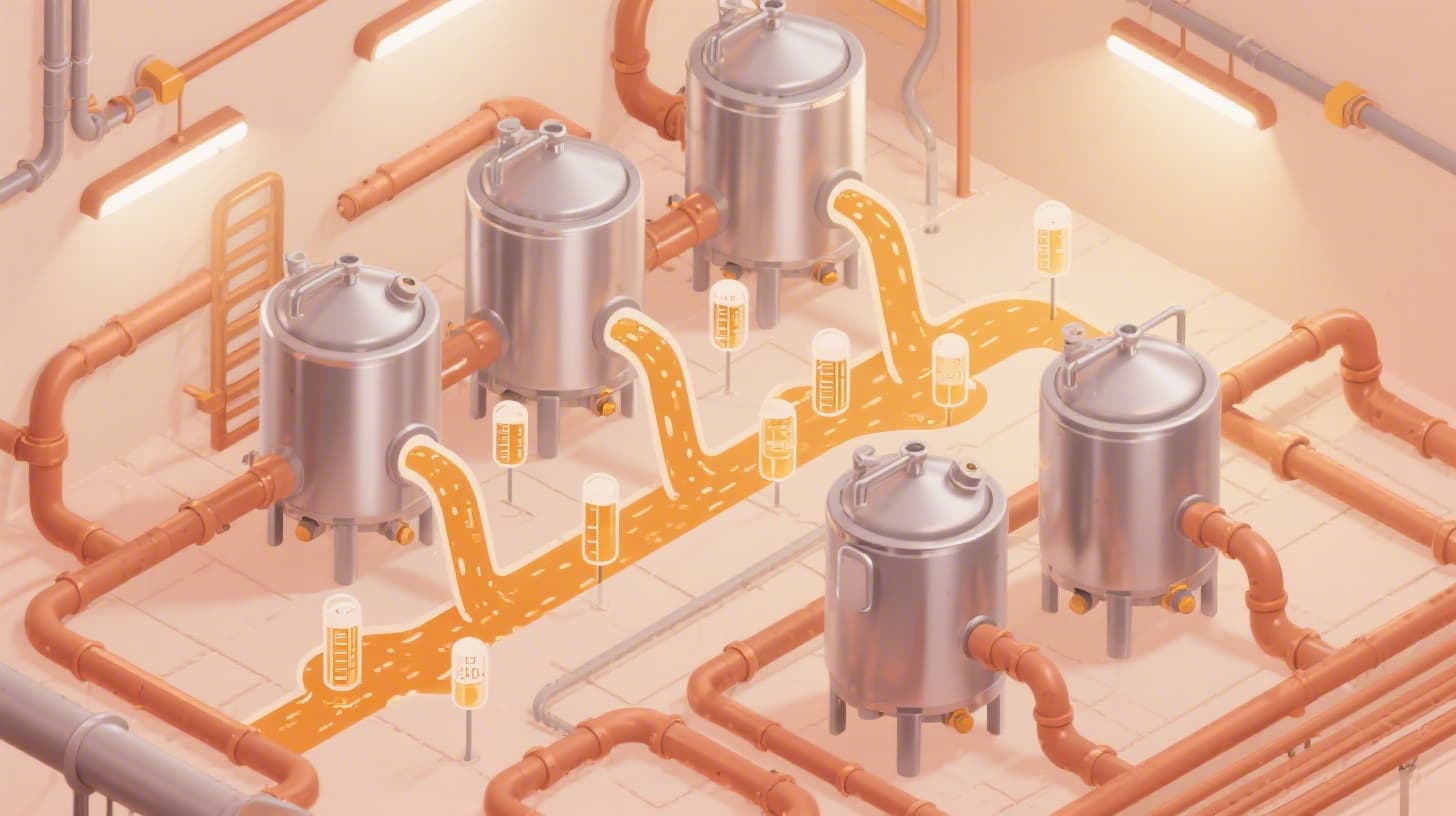
When these volume checkpoints live inside your production software alongside your tank scheduling, you get a batch-level loss report that breaks down exactly where product went. BrewPlanner's visual tank scheduling system tracks beer as it moves through brewhouse, fermenter, and brite tank phases, giving you a natural framework for recording volumes at each transition.
Use Transaction Records to Close the Loop
Inventory transactions are the backbone of loss tracking. Every movement of material, whether it's grain coming in from a vendor, beer transferring between tanks, or finished product shipping to a customer, should generate a recorded transaction with a type (IN, OUT, or TRANSFER), a quantity, and a timestamp.
This transaction log is what lets you reconcile your theoretical yield against your actual yield. If your BOM says a batch should produce 10 barrels of packaged beer, and your transaction records show 9.1 barrels shipped, you have a 9% total loss. Now you can break that 9% down by stage using your volume checkpoints and figure out which phase is contributing most.
The power here is in the pattern analysis. One batch with 9% loss might be an anomaly. Ten batches of the same recipe averaging 9% loss is a systemic issue. Twenty batches showing a gradual upward trend from 7% to 11% is a deteriorating equipment problem. You need the data to see these patterns, and you need it organized in a way that makes comparison easy.
Turning Loss Data into Cost Savings
Collecting loss data is only valuable if you act on it. The goal isn't to create perfect records for their own sake. It's to identify specific, fixable problems and measure the financial impact of solving them.
Calculate Your True Cost Per Barrel
Most breweries know their raw material cost per barrel, but that number is incomplete. Your true cost per barrel should include:
Cost ComponentWhat to IncludeRaw materialsMalt, hops, yeast, water treatment, adjunctsProcess lossesVolume lost at each stage, valued at cumulative input costLaborBrewing, cellar, and packaging hours per batchUtilitiesGas, electric, water, CO2 per batchPackaging materialsCans, labels, caps, case trays, keg maintenanceOverhead allocationRent, insurance, loan payments per barrel
When you factor process losses into this calculation, the number changes significantly. If your raw materials cost $80 per barrel and you're losing 12% of volume to process losses, your effective material cost is closer to $91 per barrel. On 2,000 barrels per year, that 12% loss represents roughly $22,000 in wasted materials alone, not counting the labor and utilities spent producing beer that never sold.
This is where the business case for better tracking becomes obvious. Even modest improvements pay for themselves quickly.
Set Benchmarks and Track Trends
Once you have a few months of loss data organized by stage, set benchmarks for each phase:
- Brewhouse loss target: 8-12% (style dependent)
- Fermentation loss target: 2-4%
- Transfer loss target: 0.5-1.5%
- Packaging loss target: 1-3%
- Total grain-to-glass loss target: 12-18%
These are general starting points. Your actual benchmarks should reflect your equipment, your beer styles, and your operating conditions. The point is to have a number to measure against, so that you notice when something goes wrong.
Build a habit of reviewing loss reports after every batch, or at minimum, at the end of every week. Look for outliers, trends, and correlations. Did losses spike on a batch that used a new grain supplier? Did a particular fermenter show higher-than-normal trub loss? Did your packaging line run poorly on a day when CO2 pressure was inconsistent?
Prioritize Your Biggest Opportunities
Not all losses are equally worth fixing. A 1% improvement in packaging efficiency on a high-volume flagship beer will save you more money than eliminating all losses on a small-batch specialty release. Focus your attention on:
- 1High-volume recipes where even small percentage improvements multiply across many batches
- 2Stages with the highest cumulative cost (packaging losses cost more than brewhouse losses because they carry all upstream costs)
- 3Losses that are trending upward, which suggest deteriorating equipment or drifting processes
- 4Losses that vary widely between batches, which suggest inconsistent procedures that training can fix
Generate reports by batch number, by recipe, by tank, and by time period. Look for patterns that point to root causes rather than symptoms. If your inventory management system tracks transactions at the item level, you can drill down into specific materials and see whether certain ingredients correlate with higher losses.
Practical Steps to Start Reducing Losses This Week
You don't need to overhaul your entire operation overnight. Here's a practical roadmap for building a loss-tracking system that delivers results incrementally.
Step 1: Audit Your Current Measurement Points
Walk through your entire production process from grain room to shipping dock. At every point where beer moves or changes form, ask: "Do we measure volume here? Is that measurement recorded somewhere? Can we compare it to the previous measurement?" Write down every gap. Most breweries find they're missing at least two or three critical measurement points.
Step 2: Digitize Your Batch Records
If you're still using paper brew sheets or disconnected spreadsheets, move your batch records into a centralized system. Every batch should have a unique identifier (batch number), a linked BOM, volume readings at each stage, and notes about anything unusual that happened during production. BrewPlanner auto-generates batch numbers and ties them to orders, tank assignments, and inventory transactions, so you get this traceability without building it from scratch.
Step 3: Build Your Loss Calculation Template
For each batch, calculate loss at every stage as both a volume number and a percentage:
- Brewhouse loss = (Pre-boil volume - Volume into fermenter) / Pre-boil volume
- Fermentation loss = (Volume into fermenter - Volume into brite) / Volume into fermenter
- Packaging loss = (Brite tank volume - Total packaged volume) / Brite tank volume
- Total loss = (Theoretical yield - Actual packaged volume) / Theoretical yield
Track these numbers for every batch. After 10 to 15 batches of the same recipe, you'll have a reliable baseline.
Step 4: Implement a Weekly Loss Review
Dedicate 30 minutes each week to reviewing your loss numbers. Compare each batch to your benchmarks. Flag anything that exceeds your target by more than 2 percentage points. Investigate the flagged batches: talk to the brewer, check the equipment logs, review the brewing notes. Document what you find and what corrective action you're taking.
Step 5: Connect Losses to Financial Impact
Translate every loss percentage into a dollar amount. When your team sees that a 2% packaging improvement on your flagship IPA saves $4,500 per year, loss reduction stops being an abstract quality goal and becomes a concrete financial priority. Use your inventory software's reporting capabilities to generate these numbers automatically rather than calculating them by hand.
The breweries that consistently reduce losses aren't the ones with the fanciest equipment. They're the ones with the best data and the discipline to act on it.
Tracking brewing losses from grain to glass isn't glamorous work, but it's some of the highest-ROI work a brewery owner can do. Every percentage point you reclaim goes straight to your bottom line. The tools exist to make this straightforward. If you're ready to stop guessing and start measuring, explore how BrewPlanner can give you full visibility into your production and inventory and turn your loss data into real savings.